Manufacture Production Model 8-24, Weapon System 201B
On 11 September 1951, Convair received a contract for its delta wing design, designated the F-102. Work on the competing Republic design was also authorized, and was designated XF-103, however, the XF-103 was so far ahead of the state of the art, it was deemed too risky to be a serious contender for the 1954 Interceptor project. This made the F-102 for all practical purposes the winner of the contest.
The USAF authorized fitting a Westinghouse J40 turbojet into the first few examples of the F-102, but production aircraft were to be powered by the more-powerful Wright J67 turbojet, which was a license-built version of the Bristol Olympus. The J40-powered F-102 was to be capable of a speed of Mach 1.88 at 56,500 feet, with the J67 production.
In order to expedite the development of its 1954 Interceptor program, the Air Force adopted the so-called " Cook-Craigie" program, named for its originators, Generals Laurence C. Craigie and Orval R. Cook, who during the late 1940s developed a concept of an aircraft development program where the usual prototype stage would be skipped. Rather than waiting to start full-scale production until the prototypes had passed flight testing and the bugs ironed out, the Cook-Craigie plan called for delivery of a small number of production aircraft during the flight testing phase so any major changes could be incorporated into permanent factory tooling in order for combat-ready aircraft to be delivered when mass production started. This program is inherently risky, as it can produce a new combat aircraft in a hurry if everything goes right during flight testing, but can result in costly and time consuming fixes in the field if unexpected problems turn up. The Cook-Craigie plan is viable if there's a high degree of confidence that the aircraft is really.
Convair Refines the LIPPISCH CONCEPT
The US pioneering aviation firm Convair, formerly Consolidated-Vultee, was an early US advocate of the delta wing planform for supersonic and hypersonic flight. Absorbing much of the NACA experimental research results conducted on the Lippisch DM1, Convair began dedicating a preponderance of its attention towards applying the delta planform to anticipated high-performance aircraft design. In 1945, subsequent to a conference attended by Convair, the US Air Force, and Dr. Lippisch, a determination was made that a new and considerably advanced interception aircraft, utilizing Dr. Lippisch's theoretical concepts, was needed; consequently, a contract was awarded to Convair for the development of a new experimental supersonic fighter aircraft under requirements of Air Force Project MX-82. The design that resulted, designated by Convair as Model 7002 (known as the "Seven Balls Two" to project engineers and soon to be identified as the US Air Force XP-92) took early form on the drawing board as a ramjet powered delta- wing aircraft with the pilot's cockpit placed inside the forward end of the ramjet intake tube. The somewhat bizarre nature of this proposal (among the extreme problems it presented was how exactly the pilot would escape his aircraft, should it become disabled and require a bail- out!) soon became recognized and a decision was made to utilize a more conventional turbojet and rocket propulsion system, after it was determined that the combination of advanced delta design and ramjet propulsion in a single test vehicle was pushing the limits of then state-of-the-art technology too far. Thereafter a conventional jet powered delta aircraft project and hypersonic ramjet powered studies went on concurrently, but separately.
Convair XP-92 (Model 7002) is Developed (XF-92A)
After a number of tests and simulations were carried out with models of the proposed design mounted on rockets, the final design for a turbojet powered delta design was configured and designated the Convair XF-92A The XF-92A was fitted with a then typically underpowered turbojet engine initially, and somewhat later with a more powerful afterburning engine. Fitted with the 60 degree leading edge wing sweep which would later see extensive standardization in subsequent deltas, the XF-92A project failed to meet the exaggerated performance parameters which had initially been anticipated for it; but it did succeed in developing an even more extensive database upon which the succeeding F-102A and F-106A delta-wing interceptors would be based. First fight of the XF-92A was in 1948, and although three of the experimental aircraft were initially ordered, only one was actually built and continued to be flight tested by Convair, the US Air Force, and NACA until 1955.
Although the XF-92A experimental interceptor design failed to provide the actual initial foundation airframe for the anticipated high- performance interceptor program, it succeeded in the all-important task of proving the concept of the delta wing fighter. As such, it remains a significant and historical ancestor of the final, perfected F-106A Delta Dart, and is an important link in the chain of events that gave rise to the ultimate interceptor' that was the Six.
MX-1554 Project
The airframe portion of the project was designated MX-1554 Project. Proposals were requested by the Air Force on June 18, 1950, and when the bidding closed in January of 1951, nine proposals had been submitted by six different manufacturers.
- Republic submitted three separate proposals
- North American submitted two
- Single proposals were made by Chance-Vought, Douglas, Lockheed, and Convair.
On July 2, 1951, the Air Force announced designs by Convair, Lockheed, and Republic had been selected to proceed with preliminary development. All three were to proceed with their designs all the way to the mockup stage, with the design deemed most promising being awarded a production contract. Later, the USAF deemed it too costly to carry through with three concurrent development programs, so it cancelled the Lockheed project entirely. The Convair and Republic entries were given the go-ahead to proceed. Republic's entry bore the company designation of AP-57 (AP stood for "Advanced Project"). It called for an extremely advanced aircraft capable of achieving a Mach 4 performance at altitudes of up to 80,000 feet. This was clearly a quantum leap in the state of the art for the early 1950s. Convair's entry was closely related to the experimental XF-92A, which Convair built in 1948 as a test bed to provide data for the proposed F-92 Mach 1.5 fighter. This work had been performed in consultation with Dr. Alexander Lippisch, who had done pioneering work in Germany on delta wing aircraft during the war, and Convair had become convinced that the delta configuration provided a viable solution to the problems of supersonic flight. The XF-92A had been the first powered delta wing aircraft to fly, but the F-92 project had itself been cancelled before any prototype could be built.
By December of 1951, it was apparent the Wright J67 engine and the MA-1 fire-control system would not be ready in time, which forced the USAF to change its plans. The Air Force had justifiable reservations about the Convair design by this time, and it was only fast and dedicated work by the Convair design team which turned what appeared initially to be a near failure into an acceptably near success. Since the US Air Force was considerably displeased by this shortcoming, Convair's contract was in jeopardy. Therefore, a major reworking of the entire airframe was immediately undertaken and within 117 days of almost non-stop work, the vastly modified F-102A took shape. The modifications were so extensive that a visual comparison of the two airframe designs instantly reveals the extent of the changes wrought in the original YF-102 to achieve more reasonable performance parameters.
The Hughes Aircraft fire control system planned for the 1954 Interceptor' had also lagged in development, and as a result it was only after extensive work that the Hughes integral fire control system was sufficiently developed and re-engineered to incorporate it into the considerably reworked YF102A airframe.
Thus only after extensive, protracted testing and development of the original components of the "weapons system" that the F-102 and Hughes fire control components together comprised, did the final standard F-102A configuration take to the air in mid-1955. In mid-year of 1956 the first production F-102A became operational, carrying the early Hughes MG-3 fire control system, along with the (AIM-4) GAR-1 Falcon air-to-air missiles that were initially its sole weapons. The final F-102A aircraft proved to be a Mach 1.22 capable aircraft with a combat ceiling of 55,692 feet. Further, with an airframe limit of Mach 1.5, the F-102A airframe proved itself unsuited as the basis for development of the enhanced ultimate interceptor' (still designated the F-I02B, and not yet as the F106A).
The aircraft, originally called the "Machete" before being named "Delta Dagger", entered service as the "interim interceptor" (F-102A) and was considerably larger and heavier than the original specifications had called for in 1951. This was due to the radical alterations that had been necessary to perfect the original subsonic YF-102 airframe. Changes contributing to extra weight included extensive lengthening of the fuselage, modifications to the wing (camber changes to augment lift coefficient and reduce drag), canopy and air intakes, and of course the reshaping of the F-102A fuselage to comply with "area rule" calculations. Nevertheless, when the final production F-102A was introduced in quantity in 1956 and 57, it was an adequate interim interceptor
In 1958 the initial MG-3 airborne fire control system was upgraded to the more advanced Hughes MG-10 development, which further enhanced the system's seek-out and shoot-down capability. Armament eventually included both the GAR-1 missiles and 2 (diameter) inch rockets stored in the leading edges of the missile doors, which were a back-up system to employ, should the GARs fail to take out their target.
Note: when the F102 was still in service test, the Stanley Aircraft Company (later famed for its egress systems) proposed a fully encapsulated pilot escape module, which it hoped to develop for all of the new Century Series aircraft. Although a working model was never built, and the F-102 had a conventional ballistic ejection seat installed, the Stanley Company did go on to pioneer many innovative egress systems of the 60s and 70s (including the encapsulated crew module used in the Convair B-58 Hustler Mach 2 bomber).
So, with all this the USAF decided to proceed with an interim version of its 1954 Interceptor, one which could be introduced into service at an early date, pending the availability of the fully-developed version later on. The interim version was designated F-102A, and the fully-developed advanced version designated F-102B. The F-102A would use the less-powerful Pratt & Whitney J57 turbojet, but the F-102B would retain the high-thrust Wright J67. The F-102A would be equipped with an interim fire-control system, but the F-102B would be equipped with the highly-sophisticated Hughes fire control system under project MX-1179. Although the F-102A was considered only an interim version pending availability of the F-102B, it ran into some unexpected developmental difficulties and fell behind schedule. A lot of money originally planned for the F-102B, now had to be diverted into fixing F-102A problems. Consequently, the F-102B fell even further behind schedule and began to lose some of its original high priority. By mid-1953, the MX-1179 fire control system (later known as the MA-1) was slipping badly. It took another year before an experimental installation could be installed aboard a T-29B for testing
At the same time, the Wright J67 engine was experiencing difficulties of its own, and the Air Force needed to consider alternative powerplants, finally settling on the Pratt & Whitney J75, which was an advanced version of the J57 used in the F-102A.
The substitution of the J75 engine for the J67 was approved in early 1955. Seventeen F-102Bs were ordered in November of 1955, with their serials ranging from 56-0451 t0 56-0467. The F-102B mockup was ready for inspection in December of 1955. On 18 April 1956, the Air Force finalized the F-102B production contract of the previous November, ear-marking all the 17 aircraft ordered exclusively for testing. One prototype was to be delivered in December of 1956, with the others to follow in January of 1957. That prototype was serial number 56-0451, the first F-106 built and was the only aircraft to carry the 'YF' MDS designation as well as still being an F-102B. The 'Y' was later dropped as 56-0451 became a full production model F-106.
Throughout the course of this transition through the F-102 to F-106, the airframe went through numerous model numbers to include 8-15, 8-16, 8-17, 8-21 which had the cancelled Wright J67 engine, 8-23 and the final F-106 model number 8-24.
The first 188 of the 340 aircraft produced had the 2-piece glass canopy with the metal framework, which on top ran right above the pilots head. Project SPEEDLINE was a MOD to replace these canopy's with a new one-piece Bubble Glass canopy. This mod took place between 1971 and 1973.
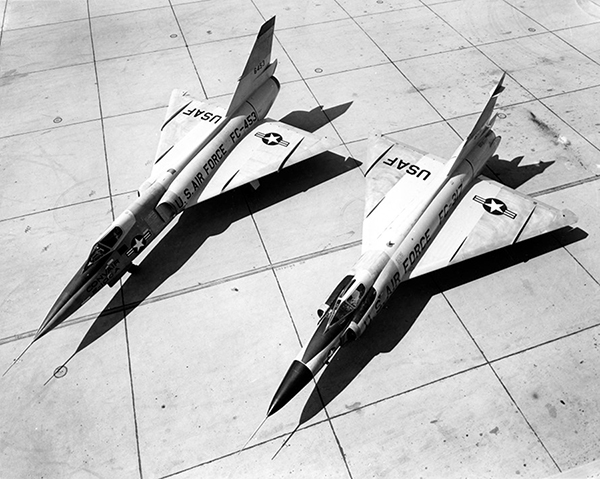
F-102B on the left was later re-designated F-106A, sitting beside an F-102A on the right
Click to open in our Photo Gallery
The first twelve aircraft were temporarily designated JF-106A for flight tests, but a total of thirty-seven, including the first two aircraft, were used for flight test development. In mid-1957, the F-106A was given the popular name "Delta Dart". Originally, the Air Force had planned to acquire 1000 Delta Darts to equip forty plus Air Defense Command (ADC) squadrons. However, by 1957 the delays in the F-106 program and the problems with the engine and fire control system had resulted in the necessity of a stop-gap measure of ordering other interceptors such as the McDonnell F-101B Voodoo, and the F-106 lost some of its urgent priority. For a while, serious consideration was given to canceling the entire F-106 program, or else redesigning the aircraft as a long-range interceptor. Although the F-106 survived intact, shortages of funds caused a drastic cutback in the number of F-106As on order. By September 1958 the total order of F-106 interceptors had been cut by a factor of three, enabling only fourteen squadrons and a training unit to be equipped. As a result, only 260 more F-106As were ordered. Since the cutback was so drastic, a decision was made in August of 1959 to convert all of the existing 35 F-106A test aircraft to operational status (Model 8-24 standards) and turn them over to the interceptor squadrons. In September of 1958, an early F-106A (serial number 57-0235) was allocated to Ames Research Center at Moffett Field in California for tests of the MA-1 fire control system. On 30 May 1959, the first F-106As were delivered to the Air Defense Command's 539th FIS at McGuire AFB in New Jersey, replacing the F-86L, however, the first "operational unit" was the 498th Fighter Interceptor Squadron at Geiger AFB in Washington. This was five years later than originally planned, and even then, numerous problems kept the Delta Dart from being declared fully operational until 31 October 1959. The remaining 13 squadrons were re-equipped with the F-106A by the end of 1960. On 15 December 1959, Delta Dart 56-467, flown by Major Joseph W. Rogers, set a world's absolute speed record of 1525.96 mph at 40,500 feet, which beat the previous record of 1483.83 mph, set by Georgiy Mossolov in a Soviet Ye-6/3 on 31 October that same year. Initial operational deployment turned up all sorts of problems; generator defects, fuel-flow deficiencies, particularly acute in cold weather, and fuel-combustion-starter malfunctions. In December of 1959, after a canopy had been accidentally jettisoned in flight, all F-106s were temporarily grounded until the problem could be fixed.
On 17 June 1956, the F-102B designation was changed to F-106A, which was in affect an official recognition of the past technical differences that had distorted the original F-102 program, and also a recognition that the F-102B was by now, a completely different aircraft from the F-102A due to so many aerodynamic changes and far more advances to include a variable-geometry inlet design. In September of 1956, the Air Force specified that the F-106A would be available by August 1958, four years later than initially planned, and it had to be compatible with the Semi-Automatic Ground Environment (SAGE) up to a radius of 430 miles and an altitude as high as 70,000 feet. Interceptions would be accomplished at speeds of up to Mach 2 at 35,000 feet, and would be capable of launching air-to-air guided missiles and rockets under the control of the Hughes MA-1 fire control system. The wing of the F-106A was virtually identical to that of the F-102A. The aircraft with FY 1956 serial numbers had outer-wing boundary layer fences as on the F-102A, which were replaced in FY 1957 with leading edge slots. The "wet" wing used no fuel bladders, and fuel transfer was accomplished using low pressure bleed-air from engine into the tanks. It was thought, however combat damage, even a single bullet hole in the wing, could incapacitate the entire system. The major external difference was in the fuselage, which had a much more streamlined shape and a "coke-bottle" design. The variable-ramp air intakes were moved well aft of the nose and mounted closer to the engine, and the shape of the fin and rudder were changed with a clamshell-type airbrake fitted at the base of the vertical fin. A new undercarriage was fitted with steerable twin-nose wheels.
On the first F-106s, the upper and lower rotating navigation beacon lights retracted when the aircraft went supersonic. They were located immediately aft of the canopy in the dorsal position and immediately behind the nose wheel on the belly of the aircraft, but the retractable feature was disabled in later years.
The Pratt & Whitney J75 twin-spool, axial-flow afterburning turbojet was the same engine which powered the Republic F-105 Thunderchief, and was rated at 15,000 lbs thrust dry, and 23,500 lbs thrust in afterburner. The pilot sat well ahead of the engine air intakes.
As with the F-102, the F-106 featured optically-flat windscreens which met at their forward edges. The metal strip that was located where the windscreens met was directly in front of the pilot's face and severely restricted his forward vision. The wingtips changed after the 1956 built F-106's.
All 1956 models has the Case 14 wing tips, while all remaining had Case 29 wingtips. The difference was the amount of leading edge camber towards the wing tips. That's why the rear of those 1956 model Case 14 wing tips had a slight upward curl. An interesting anecdote to this was in the MACH tuck region condition -- these 1956 Case 14 aircraft handled it a little bit differently in relation to the later Case 29 winged aircraft.
It was Doctor Richard Whitcomb of "Area Rule" fame whom took the lead in refining the F-106's wing designs. His refinements to the wings up to the Case 29 were wind tunnel tested at Langley through many hours of development.
The electronics package of the projects' design came first, known as the new WS-201A System. Project MX-1179 was the designation given to the portion of the project dedicated to the armament and electronic fire-control system of the 1954 Interceptor. In October of 1950, the Hughes Aircraft Company was named the winner of the MX-1179 contract, with the Hughes proposal consisting of an MA-1 fire control system acting in conjunction with GAR-1 Falcon air-to-air guided missiles. For a brief time, the Falcon missile was known as the F-98, a fighter designation.
In 1941, the US Air Force formally identified the urgent requirement for an advanced pure air-to-air weapons system, capable of meeting the threat posed by Soviet long-range bombers. Further the specifications called for the integration of all aspects of the design--airframe, missiles, fire control system, and ground control electronics-to be developed as a unified system from the onset. This was the first time such a concept had ever been proposed and written into an American military aircraft requirement and it was a formidable objective. Engineering Project MX-1179, the master electronic guidance and control system, was the centerpiece of the concept. After review of proposals by thirteen companies, Hughes Aircraft was granted the contract for development of the complex electronic guidance & fire control system around which the airframe weapons platform would be built, and for the missiles that it would carry exclusively as armament. Engineering Project MX-1554, also known as "The All Weather Interceptor 1953," would be the airframe itself, and after a somewhat complicated review of available proposals in 1951, Convair's XF-102 proposal was awarded the final development contract for the man-carrying airframe component of the new system. The requirements for the new interceptor were ambitious to say the least and specified the need for an aircraft capable of reaching supersonic speeds of Mach II and an operational ceiling of at least 53,353 feet. All of this integrated system was envisioned as being completely flight tested and ready to start active service by 1954 a very optimistic outlook, to say the least!
As was soon seen, considering the early state of the art in "advanced" jet propelled aircraft at the time, the expectations for a pure interceptor aircraft capable of this sort of extremely enhanced performance were not fully realistic. Much had yet to be done to explore the potential of both aeronautical airframe design and powerplant combinations which would prove suitable for the successful aircraft, and there were many areas of uncertainty in all areas of the project's systems which needed to be resolved before the program would bear fruit.
Convair YF-102 Prototype
Although the Convair proposal was now in the works, the Air Force was not fully convinced that Convair's projections on the drag aspects of the F-102 delta design were accurate, and in fact Clarence Kelly (chief of Lockheed's design section) went on record as stating that the delta design was not as superbly suitable for high-speed flight as was supposed (one of the few occasions when Kelly got it wrong!). Thus it was that when the first flight of the new Convair YF-102 took place in October of 1953 at Edwards Flight Test Center in California, it became rather quickly apparent that the proposed F-102 design would not achieve the ambitious flight performance levels being sought after for the Air Force's Ultimate Interceptor'. Consequently, the requirement was changed to allow for what would be termed an interim interceptor design (the F-102A), to be followed somewhat later by the definitive, very high performance ultimate interceptor version, initially designated the F-102B.
The first pre-production YF-102 Delta Dagger flight test prototypes were indeed found to be far from perfect and chief among the faults of the design was the YF-102's embarrassing inability to exceed the speed of sound in level flight (the best it could achieve was Mach .98 and 50,918 feet ceiling). This was due largely to problems with transonic drag that combined with available engine thrust insufficiency to prevent sonic penetration. Although the Bell XS-1 research rocket had in 1947 famously blasted its way through the sonic barrier by sheer force alone, available turbojet designs were not then powerful enough to overcome the drag defects in the initial F-102 design: it was only after the fuselage's proportions had incorporated changes specified by NACA aeronautical scientist Richard Whitcomb`s Area Rule that subsequent versions (designated the YF-102A) were able to achieve the sought after interim interceptor performance specifications. Supersonic wind-tunnels were still not available when the bulk of the Convair studies had been done in the late 40s, and the somewhat portly YF-102's drag problems were seriously compounded by a lack of sufficient engine thrust, a characteristic problem associated with early jet engine developments of the immediate post-war period. Together, these two obstacles resulted in the original YF-102's failure to meet expectations
The F-106B (Model 8-27) was a two-seat combat trainer version of the Delta Dart. 63 examples were ordered on 3 August 1956. The aircraft was originally intended as a pure trainer and was initially designated TF-102B and then later re-designated TF-106A. The designation F-106B was eventually chosen when in late August of 1956 the Air Force specified that full combat capability was to be provided for the two-seater.
To avoid the problems experienced with the side-by-side TF-102A trainer version of the Delta Dagger, a tandem seating arrangement was chosen. The two crew members sat under a large, single-piece clamshell- type canopy. The fitting of the aft seat reduced the fuel capacity removing a fuel cell, and displaced some of the avionics to the weapons bay. The external dimensions of the F-106B were exactly the same as those of the F-106A. The F-106B was equipped with the Hughes AN-ASQ-25 fire control system, which was equivalent to the MA-1 of the F-106A, and had the same armament capability, which was a quartet of Falcon air-to-air missiles plus one Genie rocket equipped with a nuclear warhead, all housed in the internal weapons bay.
Procurement of the F-106B was included in the third F-106A contract, but the F-106B definitive contract was not finalized until 3 June 1957.
The first flight of the F-106B (57-2507) was made on 10 April 1958. The first eight aircraft off the production line were temporarily designated JF-106B for flight tests. The first delivery to the USAF was made in February of 1959, however, the F-106B suffered from the same development problems as the F-106A single-seater, and was not declared fully operational until July of 1960.
The first 12 F-106Bs off the production line were initially allocated to testing, but they were eventually brought up to the standards of the rest of the F-106 fleet. The last F-106B aircraft were completed as Model 8-32s, with improved MA-1 fire control systems, supersonic ejector seats, vertical instrument display panels, Case 29 wings with revised camber, and with provision for 230-US gallon under-wing tanks.
Production of the F-106B ended in December of 1960 with the delivery of the last two examples.
The F-106B participated in all of the F-106A modification programs, since the aircraft were so similar. Like the F-106A, the F-106B was initially powered by the J75-P-9 turbojet later replaced by the more powerful J75-P-17. All 64 F-106Bs built received Convair's new supersonic ejector seats with two-stage booms. The Convair supersonic seats were, however, replaced by Weber "zero-zero" seats later in the 1960s, however, the F-106B never received the weapons bay cannon installation.
In the field, each ADC and ANG squadron was provided with several two seat "B" models, which were used to perform combat proficiency training and checks. They were fully capable of performing normal intercept missions.
Jump to F-106X Concept Designs page
When the Dart (or "Six") was new, it was something of a marvel to fly. Aside from its high performance flight envelope capabilities that made it a challenge to pilot, it was an extremely deadly and effective weapons system that any hostile airspace intruder had reason to fear. The heart of its deadliness was the advanced MA-1 airborne fire control system, developed by Hughes Aircraft and based upon the earlier F102A MG-10 system. Comprised of over 2512 pounds of navigational and fire control electronics, the MA-1 system's 200 separate black boxes full of hollow state devices' (vacuum tubes) formed a very formidable all-weather, fully automatic weapons suite for its time. While technologically obsolesced by today's state of the art aircraft guidance and control systems, the MA-1 system nevertheless represented the apex of contemporary aerial targeting and fire control systems of its day.
Due to advancements in SAGE and on-board data transmission links, it was fully capable of completely automatic interception and destruction of designated targets, as well as blind GCA and ILS flight in all categories of weather. In such a mode, the pilot was almost a redundant component! In the course of its development, the electronics (originally utilizing vacuum tubes in its black boxes) underwent continuous upgrading and improvement as solid state (transistorized) devices became the norm. There were, however, circumstances in which a human computer' on board was handy (such as in conditions involving fully automatic digital data link intercepts under unusual or divergent jet- stream and target heading situations), but no real Dart pilot worth his stuff would ever admit to the contrary, in any event!
It is worthwhile here to take a moment and examine a few of the characteristics & parameters of the F106A Delta Dart. With a fully loaded flight weight of over 40,992 pounds, a wing area of 705 square feet, and a single axial flow Pratt and Whitney J-75 turbojet engine rated at 24,000 pounds of thrust on full reheat, the F106A was a spectacular performer. If there was any criticism of the aircraft by its crews it was that it was hard to slow it down, for the aircraft liked to keep fast company. Zoom climb altitude was 74,255 feet, and normal service ceiling was 60,466 feet. Maximum maneuvering speed was Mach 1.9 at 42,431 feet. The length of the Six was 75 feet; its wing span was 40 feet, and its aspect ratio 2.2. Maximum speed was officially specified as Mach 2.31 at 42,431 feet altitude. Empty weight was listed as 23,695 pounds, while maximum take-off weight was given as 38,330 pounds. With two supersonic-rated external fuel tanks, each holding 360 gallons of JP4, maximum range was listed as 2,684 miles at 606.5 mph airspeed and 43,819 feet altitude, while combat radius was 572 miles with internal fuel only. Useable fuel load carried internally in the A model was 1740 gallons of JP4, stored in 8 wing tanks and one fuselage tank located behind the cockpit. Standard interception armament consisted of a combination of AIR-2A or AIR-2G Genie Nuclear Rockets, AIM4E/4F Super Falcon radar guided missiles, AIM-4G Super Falcon infrared seeking missiles, and an internally fitted General Electric M-61 20mm multi-barrel cannon with 75 rounds of ammunition (fitted only to some models later in the aircraft's development and which replaced the nuclear-tipped Genie rocket in the weapons bay).
One of the chief concerns arising with the new generation of supersonic aircraft of the Century Series, and particularly with the new Convair F106A was the need for a new generation supersonic-rated aircrew ejection seat system. The seat used in the F102A was limited in that it was not supersonic rated, nor was it useful in zero (altitude)-zero (speed) situations. In October of 1957 a requirement for a supersonic ejection system was issued by the US Air Force, which resulted in the ICESC Seat Program (Industry Crew Escape System Committee). Convair, under the supervisory administration of the ICESC, undertook primary development of a new seat that was to provide emergency escape for aircrew in all situational parameters, including supersonic and zero-zero ejections.
The ICESC Seat Program involved over 6 years of extensive testing (1 January 1956 through 30 June 1961) of the resulting Convair / ICESC "B" Seat system on rocket-powered sleds at Edwards Flight Test Center and Holloman AFB in New Mexico. These tests ultimately culminated with a live ejection test using a human volunteer at the White Sands missile test range in New Mexico. TSgt. James A. Howell ejected from a specially instrumented F106B aircraft at an altitude of 23,336 feet, and traveling at 497 mph. The seat, which employed a unique tilt-articulated, rocket boosted system, was installed in the early serial block F106A aircraft. Sled test ejections with dummies were run at speeds simulating Mach 2.5 at 9,700 meters altitude, with statistically satisfactory results. Additionally, 35 human test subject sled runs were concluded, verifying that ejections up to 560 mph airspeed were within the range of human endurance. The "tilt-seat", as some life support people came to know it, was not entirely satisfactory, however, and after several fatalities were sustained during actual in-flight emergency ejections in the supersonic rated tilt-seat, it was replaced in the F106 aircraft by a more conventional, rocket-powered seat made by the Weber Corporation (this seat was known simply as the "Weber Seat"), from 1964 through 1967. The Weber seat remained in the F106A & B type aircraft throughout the rest of the type's service life, and gave a satisfactory zero-zero escape capability, as well as a satisfactory high-speed ejection performance for almost all emergency aircrew escape situations. It should be noted that one of the motivations for replacement of the imperfect supersonic tilt-seat' with a conventional, rocket ejected seat stemmed from a gradual de-emphasis on high altitude, high speed parameter ejection capability, as actual operational experience had shown that most in-flight emergency ejections took place at much lower altitudes and slower speeds.
Another interesting aspect of the F106A advanced interceptor was that as originally designed, the first two prototype aircraft assigned to Edwards flight Test Phase Two evaluations were fitted with what would have been the first side-stick controls in an American military jet. Due to combined Convair / Air Force evolutional consensus, however, the prototype F106A aircraft were retrofitted with conventional center-stick controls (as were the subsequent production aircraft) prior to the start of the Phase Two (Air Force operational flight test) testing, and it was not until the introduction of the General Dynamics F16 Viper' that a side- controller stick became a standard military jet cockpit feature. As in other of its advanced design areas, the early form of this unique aircraft's control system was an expression of forward thinking, and had to be marginally conventionalized for practical purposes.
As with the earliest F102 interim' interceptor, the 60 degree leading edge wing sweep was kept and used just as had been called for in the original Lippisch experimental studies. In 1958 and 1959 the two-seat, air defense capable version of the Dart, designated the F106B, was delivered to Edwards Flight Test Center and following extensive testing, approximately 63 of these two-place aircraft were subsequently manufactured and used principally for training purposes (although they could be configured with the same weapons as the single seater and used for air defense, and performance specifications for both models were essentially identical).
By 1962 US Air Defense Command had 251 of the single seat F106A models, assigned to 14 squadrons in strategic sites around the perimeter of the United States. Although superbly suited to its primary area air defense role against strategic bomber penetration, by the late 60s it became apparent that there was a need to confer point-defense and general theatre air-superiority capability upon the F106. In view of its ability to engage in air-to-air refueling with world-wide deployment now possible, there was an increasing likelihood that it would come into contact with hostile fighters in some future conflict that took it out of its nominal pure interception environment. Thus a 20 mm M-61 Vulcan rotary barrel cannon was specially configured for use by the Six, the bulk of which could be carried within its internal weapons bay. The Vulcan equipped Dart was nicknamed "Six-shooter," and new training and tactics subsequently demonstrated that the venerable F106 Delta Dart was also quite well suited for use in its new air superiority role. Part of the Six-shooter modification included a new and very accurate "snapshot" gun-sight, and the installed Vulcan M-61 cannon could be carried and used with no interference to deployment of the normal load of Super Falcon missiles carried in the internal weapons bay. Among further refinements engineered into the Six was a cockpit heads-up display, an arrest barrier tail-hook, a clear bubble canopy' hood, and improved variable ramp air inlet ramps. F106 cockpit improvements included installation of advanced vertical tape' instrument displays, proven far superior to conventional "round-eye" (analogue) instrument gauges for conveying precise data quickly.
Further, over the course of its long service life, improvements in solid- state electronics provided welcome weight reductions in the massive and complex MA-I guidance and control system components, and which also reduced lengthy maintenance requirements substantially.