






















Join F-106 Facebook Group

Welcome to
F-106DeltaDart.com

Founded in 1998 to commemorate my memories as an F-106 crew chief with the 87 FIS 'Red Bulls' and 318 FIS 'Green Dragons,' the Convair F-106 Delta Dart, The Ultimate Interceptor, and the last of the USAF 'Century Series Fighters,' has evolved into an organization dedicated to preserving the complete history, lineage, and memory of everything related to the Convair F-106 Delta Dart, The Ultimate Interceptor. We share experiences and recollections of this historical World Speed Record holding aircraft as a vast "Six" community of pilots, maintainers, support staff, and aviation fans, and we're constantly searching for additional content to include - anything F-106 connected! Please Contact Us if you have any that you'd like to share. -- Patrick J. McGee, USAF (Ret)

2023 F-106 All-Troops Reunion
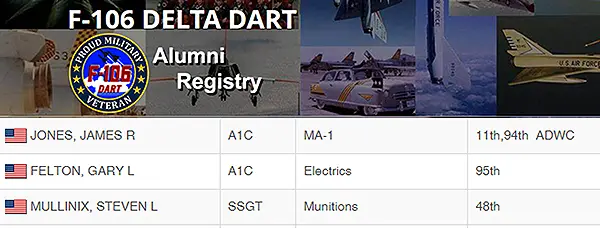
F-106 Delta Dart Alumni Registry
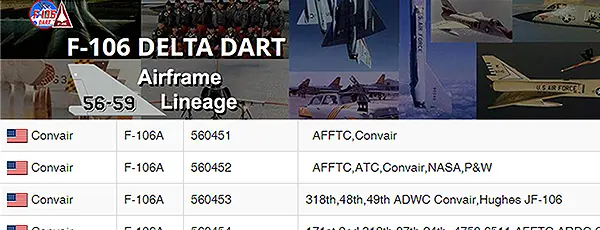
F-106 Delta Dart Airframe Lineage
F-106 Surviving Airframes Photo Gallery

F-106's Still Serving - On Display

F-106 World Speed Record

Project 'Firewall' 1525.95 MPH

F-106 Association Challenge Coin in the eStore

F-106 Association

Challenge Coin

F-106 Delta Dart Trivia and FAQ
F-106 Delta Dart History

F-106 DELTA DART HISTORY

History of Convair's All-Weather Interceptor

F-106 Delta Dart Specifications

F-106 SPECIFICATIONS

Aircraft Specifications & Characteristics

F-106 Delta Dart Survivors

SURVIVORS ON DISPLAY

Surviving airframes still serving On Display

F-106 Delta Darts in AMARG the Boneyard

AMARG BONEYARD

Last SIX F-106A 59-0130 looking for a museum home!

F-106 Delta Dart QF-106 Drones

QF-106 DRONES

'Pacer Six' Coverted 194 F-106's into Drone Targets

F-106 Delta Dart Accident Reports

ACCIDENT REPORTS

Declassified F-106 Accident Reports

F-106 Delta Dart Cornfield Bomber

CORNFIELD BOMBER

F-106A Lands without it's Pilot Lt Foust

F-106 Delta Dart Russian Bear Intercepts

BEAR INTERCEPTS

Stories and photos of Russian Bear Intercepts

F-106 Armament

F-106 Systems

F-106 Delta Dart B-1B Chase Program

B-1B CHASE PROGRAM

One of the F-106's last missions was between 1986 - 1990

F-106 Delta Dart Eclipse Project

ECLIPSE PROJECT

Reusable Tow Launch Vehicle Alternative Space Launch System

F-106 Delta Dart William Tell Weapons Meet

WILLIAM TELL WEAPON MEET

Premier Air-to-Air Weapons Meet held at Tyndall AFB

F-106 Delta Dart Interceptor Magazine of ADC

INTERCEPTOR MAGAZINE

PDF Copies of 'INTERCEPTOR' the Magazine of ADC

F-106 Delta Dart RASCAL

RASCAL PROJECT

Responsive Access, Small Cargo & Affordable Launch Vehicle

F-106 Delta Dart HAVE DOUGHNUT

HAVE DOUGHNUT PROGRAM

Evaluate and Exploit the MIG-17 and MiG-21-F13

F-106 Delta Dart Spike

SPIKE PROJECT

Kinetic-kill Anti-satellite air-launched Weapon System

F-106 Delta Dart Concepts

F-106C/D/X CONCEPTS

F-106 (Model 8-28/8-29) 1956 Advanced design studies

32 YEARS w/ NASA

There I Was

"There I Was..." Stories

There I Was Audio

"There I Was..." Audio Stories

T.O.'s, Checklists, Manuals

T.O.'s, Checklists, Manuals

Deport SM-ALC McClellan AFB

Deport SM-ALC McClellan AFB

Korea Deployment

Osan AB, Republic of Korea
1968-1970

318 FIS Korea 48 FIS Korea 71  FIS Korea 94 FIS Korea 95 FIS Korea

TDY, Exercises, Deployments

TDYs and Exercises

Today in Aviation History

F-106 Delta Dart Buzz Numbers

Fuselage Buzz Numbers

In the years immediately following World War 2, many USAAF/USAF aircraft used markings that would make it possible to identify low-flying aircraft from the ground. This was intended to discourage the unsafe practice of pilots of high-performance aircraft making low passes (colloquially known as "buzzing") over ground points. Consequently, these numbers came to be known as buzz numbers.

The system used two letters and three numbers, painted as large as practically feasible on each side of the fuselage and on the underside of the left wing. The two letter code identified the type and model of the aircraft, and the three digits consisted of the last three numbers of the serial number. For example, all fighters were identified by the letter P (later changed to F), and the second letter identified the fighter type. For example, the buzz number code for the F-102 Delta Dagger was FC and the F-106 was FE. On occasion, two planes of the same type and model would have the same last three digits in their serial numbers. When this happened, the two aircraft were distinguished by adding the suffix letter A to the buzz number of the later aircraft, preceded by a dash.

What is a
Century Series Fighter?

The Century Series fighters are a group of 6 US full production fighter jets that were numbered F-100, F-101, F-102, F-104, F-105 and F-106.

Although these were considered "2nd Generation" fighters, sharing common technology, the basis for this club was actually the "10x" numbering of full production aircraft. Of note, 2nd generation aircraft were not limited only these 6 Century Series fighters.

The 2nd Generation generally spans an era from the mid-1950's to the mid-1960's when military fighter jets made leaps in technical advancements including engine design, aerodynamics, metallurgy, electronics and weapons systems. 2nd generation aircraft generally could maintain speeds over Mach 1 in level flight. Swept wings became the norm and delta wings came into play with their Area Rule 'coke bottle' shaped fuselages reducing drag. Traditional guns became uncommon and were replaced by air-to-air missiles, some with nuclear tips.

There were other "hundreds" numbered aircraft under development during this Century Series timeframe to include the F-103, F-107, F-108 and F-109, however none of them were ever produced, some never even built. And the F-110 and number higher were not part of the 10x series numbering sequence. Below is a graphic depicting the differences.

F-106 eStore

F-106 Delta Dart Online Store
Dashboard
F-106 Delta Dart Online Store
Key Chain, Coins & More