Advanced
       Pat's World Forum
        
[ Register | Log in ]
_

F-106 Aircraft Specifications

Cockpit    Weapons    Pratt/Whitney J75-P-17    Ejection Seat

The F-106 Delta Dart is a supersonic, all-weather interceptor. Originally envisioned as an advanced derivative of the F-102A Delta Dagger and given the designation F-102B, the "Ultimate Interceptor", as it was known, entailed such extensive changes that in June, 1956, the designation was changed to F-106.  It was designed from the ground up as an Interceptor and nothing but an interceptor.  Originally designated the F-102B, it was re-designated the F-106 due to it's extensive structural changes and the more powerful Pratt & Whitney J57 engine.  The single seat F-106A first flew on December 26, 1956, was delivered to and entered operational service with the US Air Force (USAF) in May 1959 and achieved initial operational capability in October, 1959.  The two-seat F-106B made its maiden flight on April 9, 1958, achieved initial operational capability in July 1960, and retained the full combat capability of the F-106A.  All F-106 production ended in late 1960 with a total of 277 F-106A's and 63 F-106B's being built at a cost of about $5 million each.

The Delta Dart was manufactured by the Convair Division of General Dynamics. It's design, and that of its predecessor the F-102A, is closely linked to Langley and the development of "area ruling" in the early 1950's. Area Ruling, which reduces drag at transonic speeds, is reflected in the "coke bottle" or "wasp waist" shaped fuselage of the F-106. Area ruling enabled the YF-102A to easily exceed the speed of sound and subsequently led to the go-ahead for the advanced version which became the F-106. The significance of area ruling was recognized by the National Aeronautic Association which awarded the originator, Richard T. Whitcomb, its prestigious Collier Trophy for the greatest achievement in aeronautics in 1955.
The F-106 was powered by a single Pratt and Whitney J75-P-17 turbojet engine of 16,100 LB thrust (24,500 LB thrust with afterburning). Developed as an interceptor, its mission was to shoot down other aircraft, bombers in particular. It used a Hughes MA-1 electronic guidance and fire control system, which after takeoff would be given control of the aircraft to fly it to the proper altitude and attack position. Then it can fire the Genie Air 2A Nuclear Rocket and Hughes Aim 4 Falcon missiles, break off its attack run, and return the aircraft to the vicinity of its base. The pilot takes control again for the landing.

The F-106 also came in a 2 seat "B". Unlike other popular 2 seat aircraft, such as the F-4, the back seater in the "SIX" had the exact same control capability as the front seater. He could fly the aircraft and perform all operations from his rear seat. The F-106B also could carry the same armament.
On December 15, 1959, Colonel Joe Rogers piloted an F-106A to a World Speed Record of 1,525.695 mph (Mach 2.41). The F-106 still holds the record as the fastest single-engine turbojet-powered airplane.

The F-106 served with the USAF Air Defense Command (ADC), Tactical Air Command (TAC), and Air National Guard (ANG). The Air Force retired the F-106 from active squadron service after a long and distinguished career. The post Delta Dart period saw them used as drone targets during air-to-air missile training for our current generation of fighter aircraft, the Eclipse Tow Project, and many are on Static Display in aircraft museums throughout the Unites States.

Engine:
One Pratt & Whitney J75-P-17 turbojet, 17,200 lb.s.t. dry and 24,500 lb.s.t with afterburning.  Click to hear it

Maximum speed:
1525 mph at 40,000 feet (Mach 2.31)
1327 mph at 35,000 feet

Cruising speed:
650 mph

Landing speed:
173 mph Initial climb rate was 42,800 feet per minute

Range:
Combat radius 575 miles
1,500 miles ("A" model)
    575 miles ("B" model)
Max range w/max ext fuel 1809 miles
Max ferry range 2700 miles at 610 mph at 41,000 feet

Service Ceiling:
53,000 feet ("A" model)
55,005 feet ("B" model)

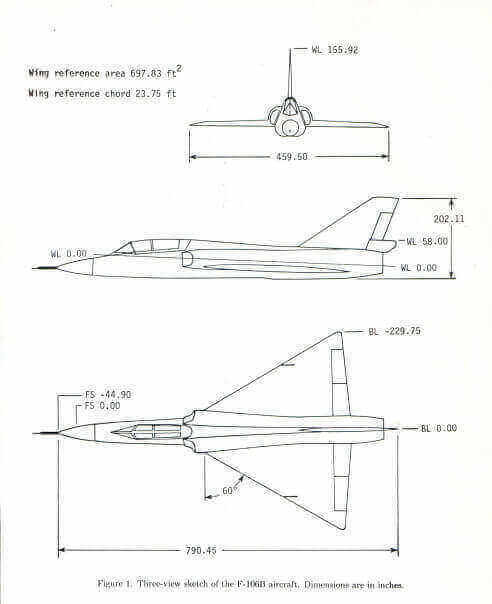
Wingspan:
38 feet, 4 inches    ("A" model)
38 feet, 3.5 inches ("B" model)
Wing Area 697.8 square feet

Length:
70 feet, 8 3/4 inches

Height:
20 feet, 3 1/4 inches

Weight:
23,646 pounds empty
38,700 pounds combat
35,500 pounds gross
41,831 pounds maximum takeoff

Fuel Load (Max):
21,440 US gallons

Armament:
One Douglas AIR-2A
Genie air to-air nuclear tipped rocket
Four AIM-4 Falcon air-to-air missiles
M61A1 Vulcan 20MM Cannon

Cost: $3,305,435


Copyright © Patrick J. McGee and Pats-world.com 1998-2007 All Rights Reserved.   

This site hosted by Interland

smilies page
forum buttons