
Operation Red Fox was a military operation in Korea between 7 Feb 1969 - 1 May 1970 involving the deployment of US Air Force F-106 Delta Dart fighter-interceptors to Korea in 1968 to bolster defenses during the USS Pueblo capture incident. It was codenamed "Project College Cadence". The deployment of F-106s was to Osan Air Base in South Korea and was a direct response to the USS Pueblo incident in January 1968, where a US Navy intelligence ship was captured by North Korea. The F-106s were deployed to reinforce air defenses and deter further aggression from North Korea.
This deployment marked the first combat deployment of an ADC F-106 fighter-interceptor squadron in the Six's history. F-106 F.I.S. units 318th, 48th, 71st, 94th, 95th had the distinction of flying across the Pacific ocean to sit Alert at Osan Air Base, South Korea.
The Korean buildup for Operation Red Fox was a result of the USS Pueblo crisis where North Korea seized a US Navy ship on 23 Jan 1968. Following the release of the 82 Pueblo crew POW's on 28 Dec 1968, the Sixes remained at Osan and flew shotgun for the EC-121 Constellation after one was shot down by North Korea 15 Apr 1969.
The First F-106 unit to deploy was the 318th FIS McChord AFB, which departed McChord AFB on 7 Feb 1968 arriving first at Hickam AFB HI enroute to Naha Okinawa. They conducted In-flight Refueling (IFR) en route, the first such long flight refueling of F-106's. Earlier IFR missions had occurred just prior to this Pacific Ocean crossing within the US to test and prepare for this long haul. In reality, the first deployment was not intended and did not go to Korea, rather to Okinawa. By 11 Feb 1968 400 men and 18 aircraft were in-place at Naha Okinawa. One week later on 18 Feb the Green Dragons of the 318th FIS packed up and moved to Osan AB Korea. Within 3 hour of arriving at Osan the 318th had 4 aircraft up on 5-minute alert.
The Last F-106 Unit to serve in Korea was the 95th FIS which departed Korea on 1 May 1970. In between these first and last unit deployments also saw the 48th, 71st and 94th FIS's deploy. All the engine shop work for the F-106's deployed to Korea was done at Kadena AB, Okinawa Japan. Here is an exerp of a message from Frank Fawcett "I was later sent over to Okinawa with the 95th from Dover when it was their [95th deployment to Korea] turn. The planes were in Korea and we did the shop work on the engines at Kadena AB, Okinawa.
The ALMOST Last Unit The 460 FIS was to replace the 95th FIS at the end of its deployment. However, it was canceled literally at the last minute. A story by Larry Worsham a member of the 460th who had just moved to Kingsley Field in late 1969 had a two month TDY to Tyndall starting in February of '70. Upon returning he was supposed to be part of the 460th to serve in that Korea rotation. The flight was set for Sunday morning. An hour before he was supposed to leave a knock at his barracks door informed him the trip was cancelled.
Just over a year after seizing the USS Pueblo from international waters, North Korean MiGs shot down a US Navy EC-121 reconnaissance aircraft with 31 crewmen during its routine mission some 100 miles east of the North Korean coast.
Within seven minutes, the Osan-based 71st Fighter Interceptor Squadron, flying the F-106 Delta Dart, were in the air on combat air patrol, and in 30 minutes the USAF launched an HC-130 search aircraft from Tachikawa.
On 20 April, the USAF ended the search and rescue effort, finding no survivors. Soviet naval forces aided the search operation.
The 71st Fighter Interceptor Squadron had the distinction of being deployed to sit Alert at Osan AB, South Korea, as part of the Korean buildup for Operation Red Fox, stemming from the USS Pueblo crisis where North Korea seized a US Navy ship on January 23, 1968.
Following the release of the 82 Pueblo crew POW's on 28 Dec 1968, the USAF kept aircraft at Osan to fly escort for the continuing EC-121 Constellation recon flights after North Korea shot down this EC-121.
After the aggressive actions like the Pueblo capture, EC-121 shot-down and other events, the USAF would permanently station a fighter wing at Osan, the 51st Fighter Wing, which has been in Korea since it was reactivated in November 1971.

Find more information: https://en.wikipedia.org/wiki/1969_EC-121_shootdown_incident

It was the first unit to deploy for this mission and remained until 11 Jul 1969. The 318th was also the first ever F-106 unit to fly across the Pacific ocean conducting unprecedented in-flight refueling en-route. Personnel stayed until Dec 1968 when they were relieved by the 48th, but personnel only not aircraft. The 318th aircraft remained at Osan while 48th aircraft back home flew to the 318th McChord AFB. Many of the jets were transferred between the 318th and 48th units while on location in Korea, some several months before the 48th ever arrived in Korea. 48th pilots flew the previous 318th jets in Korea, now assigned to the 48th, and then back CONUS in June 1969 when the 48th departed Korea and returned to Langley.

The 48th relieved the 318th FIS 'personnel', keeping the 318th aircraft on-station, and remained until Dec 1968. The 48th, minus planes and equipment, served a 180 day tour plus an extension. They flew the 318th aircraft that remained at Osan during this rotation, while their 48th aircraft went to the 318th at McChord AFB. Many of the jets were transferred between the 318th and 48th units while on location in Korea, some several months before the 48th ever arrived in Korea. 48th pilots flew the previous 318th jets in Korea, now assigned to the 48th, and then back CONUS when the 48th departed Korea and returned to Langley. One of the biggest ADC practical jokes ever caried out was done by the 48th personnel when prior to ADC Commander Lt Gen Arthur Agan was to arrive to visit the unit, which ADC leadership often did, the 48th borrowed two multiple-ejector bomb racks from the F-4 guys at Osan and installed them, with twelve (12) 500lb bombs on the external wing tank pylons of F-106A 59-0047, which was still carrying 318th tail flash markings. It was a well received joke when the General arrived.

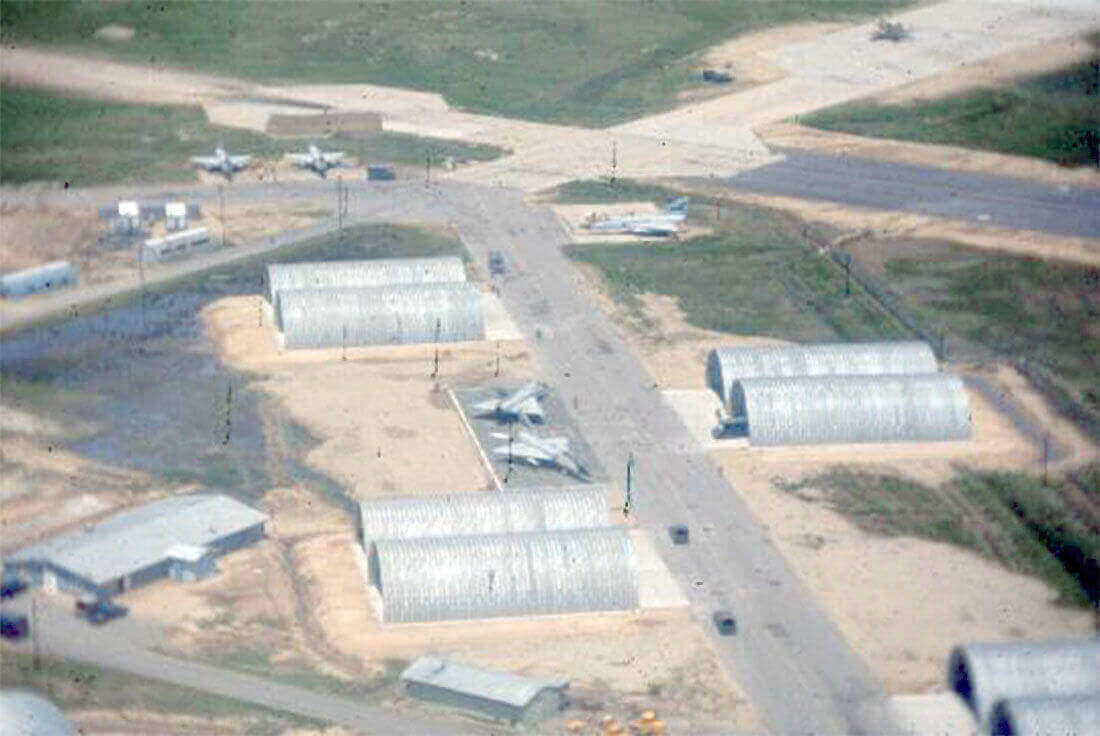
Joining the 48th FIS currently there, and remained until 9 Jun 1969. The 71st brought their own aircraft over with them flying them over in three separate movements. The 48th flew the 318th aircraft back CONUS. Things heated up in Korea while the 71st was deployed when North Korea shot down a Navy Lockheed EC-121M recon aircraft over the Se of Japan on 15 Apr 1969. The 71st launched four-ship Combat Air Patrol (CAP) alert aircraft, escorted and protected the other aircraft now performing searches for survivors and in-flight refueling from KC-135 Tankers from Kadena AB Okinawa to continue long missions. Flights we normally 4 1/2 hours and this lasted for 3 days at which time the CAP's were discontinued. However, on 3 May 1969 the CAP's were reconstituted and flew until 24 May. Also during the 71st's time in Korea construction was abundant with new concrete shelters being built, although concrete was not yet laid to make them flow-throughs so aircraft push-backs were still required when recovering them.
Story About LtCol Ellis E. Stanley, Commander, 71 FIS (One of the two pilots to initially scramble), as told by Frank Wilson
My candidate for the hairiest launch of F106 aircraft took place on April 15 1969 by the 71st FIS from Osan AFB, Korea. I worked in the command post of Air Forces Korea sitting right next to the Commander AFK/314 Air Division writing the logs and outgoing messages, so was in a perfect position to "see all the action". We had just received word the EC-121 Navy Surveillance aircraft was under attack off the east coast of Korea, and the commander ordered the launch of the two 5min alert F106s. When the launch order got to the flight line and that this was a real launch the 71 FIS Commander, Col Stanley, and his operations officer "pulled rank" and took the mission personally. The two F-106 got airborne in well under 5 minutes, about 3 minutes or a bit less I remember. They flew across Korea south of the DMZ and out over the Sea of Japan to the area where the EC-121 was last reported and found nothing as the EC-121 had been shot down by the North Koreans by this time. The two F-106s continued north over the ocean and finally after traveling several hundred miles north, (the F-106s) had the supersonic long range tanks), out of our radar coverage. Finally the F-106s turned around and headed back toward South Korea. When they entered our radar coverage again the controllers at the radar site detected that the F-106s were being tailed about 50 miles back by two North Korean aircraft, presumably Migs. The F-106s did not have enough fuel to turn and chase the MIGs so they throttled back to let the Migs catch up! The Migs finally broke off at 20 NM and headed back to North Korea, just before a dog fight would have started. When the two F-106s landed and were debriefed - I was present at the debriefing - there were two very pissed off F-106 pilots who were calling the Migs cowards and worse terms. Both F106 pilots were convinced they would have bagged a MIG.
In his next trip to Naha Okinawa Col. Stanley related the entire story. He indicated that the F-106s were scrambled he bumped one of the pilots to go. I recall him saying there were four 6s. When they got to the site of the shoot-down they were told to stay as high cover. He said, "Being the good squadron command that I had two stay high and my wingman and I went down to look for action." All they found was debris. They learned later that the North Korean air base where the attackers had taken off from was evacuated, not knowing what the U.S. response would be. There were two F-106s already airborne, the first two alert birds to scramble, when Col Stanley "pulled rank' and took lead in the second pair of Sixes. Those first pair of F-106's had become airborne earlier to replace two F-102s on CAP.
Name of the second of the two pilots to initially scramble is unknown.
Bill Halpin, Crew Chief recovering those first alert scrambles states "I helped recover those alert birds upon their return to Osan and when I was retrieving the pilots helmet bag he pointed towards the Armament Safety Switches that had their copper safety wires broken - something you didn't often see in the Six."

Relieving the 71st FIS personnel only and stayed until 16 Nov 1969. The 71st aircraft however remained and was reassinged to the 94th. Since the 71st and 94th were both assigned at Selfridge ADC decided to swap aircraft between the two units to eliminate flying them back and forth. The 94th jets at Selfridge were transferred over to the 71st, which the 71st personnel and pilots took over upon their return from Korea. Because the 71st jets remaining in Korea were now officially 94th jets, for the first time a Six unit repainted their tail markings while overseas. Upon its return, in recognition for its role in Korea the Fighting 94th was presented the ADC "A" award for outstanding performance by an ADC fighter squadron. General McGhee, then commander of the 5th Air Force in the Republic of Korea, also presented an award for outstanding performance. The ADC "A" award can be seen in some of the photos in the photo gallery on the vertical tails of the 94th jets. The 94th's replacements, 95th FIS, assummed alert committment on 15 Nov 1969 and the 94th began their return flights back home the next day 16 Nov. That last day of alert duty however, was an exciting one with with eight (8) seperate scrambles in just that last day.

Relieving the 94th and remained until 1 May 1970. The 95th FIS was the final F-106 unit to deploy and serve in Korea for this mission.. and ever. F-106's never went back to Korea. The 95th flew their aircraft to the West Coast of the US, then Hawaii, Guam, Okinawa and Korea. They assumed the alert commitment on 15 Nov 1969, and the 94th began their return flights back home the next day 16 Nov. The 94th's aircraft had been in Korea 1 year - 6 months as the 71st and 6 months as 94th. By this time of the 95th rotating to Korea, the rotations were so commonplace that 7th Air Force decide to give them an Operational Readiness Inspection (ORI), the first time a TDY unit had one. The 95th was the only Six unit to lose and aircraft while in Korea with F-106A 57-2500 lost during a night mission in preparation for the ORI. Pilot Capt. Francis W. Dahl Jr. was killed in that crash. ADC had tentatively directed the 460th FIS to prepare to replace the 95th, and although this was known to the pilots and personnel rumors began to grow that the 95th would be permanently transferred to PACAF. However, two weeks before the 460th was to arrive the Combat Fox deployments were cancelled and the 95th returned home to Dover AFB.
Defense Technical Information Center
Accession Number : ADA586301
Title : Project CHECO Southeast Asia Report. The Pueblo Incident
Corporate Author : PACIFIC AIR FORCES HICKAM AFB HI CHECO DIV
Personal Author(s) : Burtenshaw, Edward C ; Fulgham, Dan D ; Walls, James W
Report Date : 15 Mar 1970
Pagination or Media Count : 65
Report - Full Text (PDF File)
THE PUEBLO INCIDENT - 15 April 1968 - DECLASSIFIED
THE PUEBLO INCIDENT - 15 April 1968 - DECLASSIFIED [Orig download location]
Abstract : This CHECO report addresses the events leading to the shootdown of the Navy EC-121, immediate U.S. Air Force reaction, search efforts, and retaliatory planning.
The insidious nature of the current North Korean Government continues to pose a serious threat to the security of South Korea, and to the policy of the United States. Its actions, while not directed by an overall
Asian Communist policy, must be evaluated in relation to the threat imposed by all Asian Communist countries. Results obtained from incidents such as the destruction of the EC-121 have in the past given North Korea
considerable prestige and recognition among Communist nations, and are used to justify its requests for more economic and military aid. There are no indications the policy will change. On-going studies in the realm
of Joint Command and Control are being conducted within all military services in the Pacific Command to optimize the Allied posture to counter North Korean tactics. A lectern for surveillance, these plans could be
tested again.
Descriptors: *AERIAL RECONNAISSANCE , *AIR FORCE OPERATIONS , *DOWNED AIRCRAFT , *NORTH KOREA , ELECTRONIC AIRCRAFT , ELECTRONIC RECONNAISSANCE , LESSONS LEARNED , MILITARY HISTORY ,
SOUTHEAST ASIA , VIETNAM WAR
Subject Categories: Military Operations, Strategy and Tactics
Distribution Statement: APPROVED FOR PUBLIC RELEASE
Declassified: DECLASSIFIED BY AF/HOH, 2010/13
OSAN AIR BASE, Republic of Korea -- At approximately 1345 hours on 23 January 1968 (Korea Time), North Korean, officially the Democratic People's Republic of Korea (DPRK) patrol boats seized the USS Pueblo, a US Navy intelligence-gathering vessel, in international waters of the East Sea near Wonsan, North Korea. One USS Pueblo crewmember was killed in the boarding, with 82 taken POW, and later held captive for 11 months.
The seizure took place two days after a North Korean commando team attempted to assassinate Republic of Korea President Park Chung Hee in Seoul. These incidents only highlighted ongoing provocations by the North over the previous several years which had been known as the "Second Korean War."
The USS Pueblo seizure shocked the Free World with strong public sentiment in the US calling for firm retaliatory action against North Korea. However, the US was deeply involved in the South Vietnam conflict which required enormous amounts of military assets. Yet, the seizure served as a catalyst to strengthen US commitment to South Korea over the following months.
Once word was received by the civilian and military leadership in Washington DC that the USS Pueblo was boarded and seized by the NK forces, they immediately weighed their options in attempting a rescue and recovery of the crew and ship. Outright military action was considered, but deemed too risky. Complicating the situation was the beginning of the Battle of Khe Sanh in South Vietnam followed by the Tet Offensive at the end of the month. Concerned that military action would put the crew at risk, President Lyndon B. Johnson began a diplomatic campaign to free the men through the United Nations Security Council. However, he also ordered a buildup of USAF forces on the Peninsula on 26 January to include activation of Air National Guard (ANG) units.
When the USS Pueblo was taken, USAF combat forces on the Peninsula were limited to rotation of fighters to Osan and Kunsan ABs from bases in Japan. The fighters had been on special alert, and would not have provided immediate air coverage.
Within 2 hours after the USS Pueblo seizure, the Fifth Air Force commander, who was located at Fuchu AS, Japan, and had overall responsibility for operations for USAF activities on the Korean Peninsula, ordered the 18th Tactical Fighter Wing's (TFW) 12th Tactical Fighter Squadron (TFS) with 34 F-105s to deploy from Kadena AB, Okinawa, to Osan AB, and the 475 TFW's 356 TFS with 14 F-4Cs to deploy from Misawa AB, Japan, to Kunsan AB. While partial deployment of both units occurred late on 23 January, the remainder of these elements arrived in South Korea on 29 January. The 51st Fighter Interceptor Wing's 82d Fighter Interceptor Squadron (FIS), based at Naha AB, Okinawa, also was tasked to deploy to South Korea. The squadron arrived at Suwon AB on 30 January with 22 F-102s. A fourth PACAF unit-- the 12 TFW's 558 TFS, based at Cam Ranh Bay, South Vietnam--further was tasked to deploy, and arrived at Kunsan AB with 14 RF-4Cs on 4 February, and then moved to Taegu AB on 10 March.
Once the National Command Authorities decided upon a course of action, the Joint Chiefs of Staff (JCS) ordered a buildup of USAF forces in South Korea on 26 January while directing three naval carrier groups which had been dedicated to the conflict in South Vietnam to take stations off the coast of South Korea.
The USAF response to the USS Pueblo crisis was dubbed Operation COMBAT FOX. It became a two-phase operation with initial deployment by active duty units followed by Air Reserve (AFR) and Air National Guard (ANG) units. Initial deployment of more than 180 combat aircraft to South Korea and Okinawa came from units within PACAF, Tactical Air Command (TAC), Strategic Air Command (SAC) and Aerospace Defense Command (ADC).
The following TAC units deployed to South Korea: the 4 TFW, based at Seymour-Johnson AFB, North Carolina, deployed with three combat squadrons (334 TFS, 335 TFS, and 336 TFS) and 72 F-4Ds to Kunsan AB between 31 January and 4 February; the 363d Tactical Reconnaissance Wing's 19th Tactical Electronic Warfare Squadron, from Shaw AFB, South Carolina, deployed with six EB-66s to Osan AB on 3 February. The squadron, however, moved to Taegu AB on 12 February to make room for the 4537th Electronic Warfare Squadron, Nellis AFB, Nevada, and its six specially-configured F-105 Wild Weasel aircraft which deployed to Osan AB by 4 February.
The JCS also directed that SAC deploy a squadron each of B-52s and KC-135As to Kadena AB. Strategic Air Command's 91st Bombardment Wing, Glasgow AFB, Montana, deployed its 322d Strategic Reconnaissance Squadron and 907th Air Refueling Squadron with 15 B-52Gs and 10 KC-135As to Kadena AB in early February.
Of note, ADC's 318 FIS, flying F-106s based at McChord AFB, Washington, deployed on 11 February with stops at Hickam AFB, Hawaii, and Naha AB, Okinawa. The squadron landed at Osan AB on 18 February., and was the first ADC unit ever to deploy overseas.
Aside from combat units being deployed, civil engineering Prime BEEF teams made up of personnel in the Continental United States (CONUS) rushed to South Korea to provide immediate facilities construction and support. Concurrently, HQ USAF activated the 557th Civil Engineering Squadron (Heavy Repair) (RED HORSE) in February 1968, quickly manned it with personnel from CONUS units, and provided them with special construction and weapons training before deployment to Osan AB by 24 March 1968. The 400-man squadron then sent detachments to four other bases (Suwon, Kunsan, Taegu, and Kwangju) to augment the PRIME BEEF teams in construction of facilities and quarters for approximately 8,000 TDY personnel.
To ensure that the deployment of combat and support units was accomplished safely and efficiently, HQ PACAF's 315th Air Division, based at Tachikawa AB, Japan, directed airlift operations for the contingency. Aside from its C-130 fleet, the division was augmented by the C-130-equipped 38th Tactical Airlift Squadron (TAS), Langley AFB, Virginia, and 779 TAS, Pope AFB, North Carolina for intra-theater airlift.
Military Airlift Command (MAC) supported the massive airlift operation of personnel and equipment with C-124s, C-133s, and C-141s at Osan, Kimpo, and Kunsan ABs. During the first three weeks of Operation COMBAT FOX, MAC aircraft moved 7,861 passengers and nearly 12,800 tons of cargo in 836 missions to Korea and Japan.
By the summer of 1968, most of the deployed units returned to their home bases as other active duty, AFR, and ANG units arrived in South Korea. When President Johnson approved the initial deployment on 26 January, he also signed mobilization orders for 12 ANG units of which two--the 127 TFS and 166 TFS--later deployed with F-100Cs to Kunsan AB in July 1968. Additionally, a number of AFR and ANG personnel deployed to each base to serve in base support activities.
As the USAF established its forces on the Korean Peninsula, negotiations between the United Nations Military Armistice Commission and North Korea continued at Panmunjom through the year. Eleven months after the seizure, North Korea repatriated the USS Pueblo crew and one set of remains to the US through Panmunjom on 23 December 1968. The ship remained in the Wonson Harbor, North Korea (The ship later was transported to Pyongyang in 1999). It is the only active duty USN ship to be held in captivity by a hostile foreign power. Operation COMBAT FOX wound down by early 1969 after the release of the crew; however, rotational deployments of combat units to South Korea continued indefinitely.
What seemed like a weak and indecisive response to the USS Pueblo seizure, in reality, was a signal to North Korea that US military forces would be brought to bear against any designs to invade the Republic of Korea. Headquarters Fifth Air Force had been aware of the Pueblo mission, but it had not been a part of any contingency planning; yet, it still responded almost immediately to deter any further provocations by North Korea. The crisis further engendered a renewed commitment by the US to strengthen not only the USAF on the Peninsula, but also those of the ROK Air Force. The USAF fighter deployments continued after Operation COMBAT FOX, and eventually led to the permanent basing of the 3 TFW at Kunsan AB on 15 March 1971.
Defense Technical Information Center
Accession Number : ADA586295
Title : Project CHECO Southeast Asia Report. The EC-121 Incident, 15 April 1969
Corporate Author : PACIFIC AIR FORCES HICKAM AFB HI CHECO DIV
Personal Author(s) : Barnes, William C
Report Date : 15 Apr 1968
Pagination or Media Count : 133
Report - Full Text (PDF File)
THE EC-121 INCIDENT- 15 April 1969 - DECLASSIFIED
THE EC-121 INCIDENT- 15 April 1969 - DECLASSIFIED [Orig download location]
Abstract : With attention of the wold focused on the fate of the USS Pueblo, the reaction of USAF units to the incident, and the posture of the United States Air Force in Korea prior to, during, and after the incident become of interest. Certain facts are evident in a close examination of events as they occurred on 23 January 1968. First, the increasing tempo of U.S. activities within SEA, and the attendant demand for air assets, have materially affected the capabilities of air units within WESTPAC North to respond to emergencies. Second, command arrangements and related responsibilities appear as complicated today as they did 14 years ago. Finally, the importance of achieving central control and direction of all air assets, which was so laboriously learned during the Korea action 1950-1953, has been re-emphasized. All of these points are addressed in detail in the following pages; To permit timely publication, the period covered by this report is 22 January through 29 February 1968.
Descriptors: *AIR FORCE OPERATIONS , *KOREA , KOREAN WAR , LESSONS LEARNED , MILITARY FORCE LEVELS , MILITARY HISTORY , NORTHEAST ASIA , SOUTHEAST ASIA , VIETNAM WAR
Subject Categories: Military Operations, Strategy and Tactics
Distribution Statement: APPROVED FOR PUBLIC RELEASE
Declassified: DECLASSIFIED BY AF/HOH, 2010/13
OSAN AIR BASE, Republic of Korea -- At 0445Z hours on 15 April 1969, following the release of the 82 Pueblo crew POW's on 28 Dec 1968, North Korean jet fighters shot down a propeller driven United States Navy Lockheed EC-121M 'Warning Star' Super Constellation of Fleet Air Reconnaissance Squadron One (VQ-1) on a reconnaissance BEGGAR SHADOW mission at 131° 48'E, 41° 13'N.
At 1504471, 5AF AQVON received not1ficaton from its warning center of a possible shoot-down of the BEGGAR SHADOW mission. -Due to the sensitive nature of the mission, there was limited information available; however, based on the warning center information, 5AF ADVON ordered the scramble of two F-102s from Suwon AS, Korea. at 1~0504Z. At that time, there were eight USAF and two South Korean Air Force (ROKAF) interceptors on five-minute alert. Had they been directed to scramble, there distance relative to the shoot-down and speed capacity would have resulted in the following time to target with 15-minute canb4lt time and normal fuel reserve.
Of the eight (8) US aircraft on 5 Minute Alert (4 F-106, 4 F-102) two F-106's were scrambled as directed by 5AF ADVON to take up Combat Air Patrol (CAP) at the eastern end of the DMZ and await instructions. At 150553Z, two F-106s from Osan scrambled and replaced the F-102's. This CAP was maintained by alternating the F-102's and F-106's.
The first U.S. aircraft at the scene were fighters launched from South Korea. They arrived at 0753Z on 15 April and departed at 0807Z on the same day after reporting neither electronic nor visual contact.
CINCPAC and 5AF coordinated on the feasibility of using a surface fleet in the search effort. Authority to proceed with the movement of the destroyers, USS Tucker and Dale, was given at 150835Z. At 150938Z, HC-130 rescue aircraft, KC-135 tanker, and four F-106 CAP aircraft rendezvoused at CAP point 39° 39'N - 130° 30'E. The F-106s refueled and the HC-130 with CAP proceeded to the search area.
Yes, Frank Wilson is possibly one of the very few individuals remaining with personal detailed knowledge from the Korea command level of the two incidents USS Pueblo and EC-121 Shoot-down. He was sent to Korea in September 1968, promoted from 1Lt to Captain shortly after arriving. He was a Radar Weapons Controller by AFSC, but spent his time in Korea as a controller at the OL Wesonbong radar site on the Dong Bo peninsula south of Kunsan AB, as OIC of a Special Operations Radar site located on a mountain top in the 38 parallel in the middle of Korea, OIC of a small section in HQ 314th Air Division Osan AB who tracked all combat aircraft in Korea and published daily alert orders for the 314AD and Air Forces Korea, coordinated several times daily with the Director of Operations 314AD/AFK and sit behind the operations officer whispering in his ear when an aircraft operational readiness question came up. He was eventually given the task of going through all the 314AD's papers on the USS Pueblo Incident and being the Commanders message writer throughout the EC-121 Incident and directly contributed to the data used in the Contemporary Historical Examination of Current Operations (CHECO) reports. Needless to say, Frank was hands-on with both of these incidents and was a great source of the information here.