F-106 Eclipse Project
By Tom Tucker
NASA History Division
Office of Policy and Plans
NASA Headquarters
Washington, DC 20546
Monographs in
Aerospace History
Number 23
2000
NASA SP-2000-4523
Home / Eclipse
March 3, 2025
The purpose of the project was to demonstrate a reusable tow launch vehicle concept conceived and patented by KST. Kelly Space obtained a contract with the USAF Research Laboratory for the tow launch demonstration project under the Small Business Innovation Research (SBIR) program.
The USAF SBIR contract included the modifications to turn a QF-106 into the Experimental Demonstrator #1 (EXD-01), and a C-141A aircraft to incorporate the tow provisions to link the two aircraft, as well as conducting flight tests. The demonstration consisted of ground and flight tests.
The project goal was to successfully tow, in-flight, a modified QF-106 delta-wing aircraft with an Air Force C-141A transport aircraft. This would demonstrate the possibility of towing and launching an actual launch vehicle from behind a tow plane. Dryden was the responsible test organization and had flight safety responsibility for the Eclipse project. Dryden provided engineering, instrumentation, simulation, modification, maintenance, range support, and research pilots for the test program.
The Air Force Flight Test Center (AFFTC), Edwards, California, supplied the C-141A transport aircraft and crew and configured the aircraft as needed for the tests. The pilot of the C-141 toe plane was Maj Stu Farmer who after the Eclipse work was assigned to the 586 FLTS at Holloman in 1998. The AFFTC also provided the concept and detail design and analysis as well as hardware for the tow system and QF-106 modifications. Dryden performed the modifications to convert the QF-106 drone into the piloted EXD-01 (Eclipse Experimental Demonstrator -01) experimental aircraft. Kelly Space and Technology hoped to use the results gleaned from the tow test in developing a series of low-cost, reusable launch vehicles. These tests demonstrated the validity of towing a delta-wing aircraft having high wing loading, validated the tow simulation model, and demonstrated various operational procedures, such as ground processing of in-flight maneuvers and emergency abort scenarios. Two QF-106's, previously assigned to 5th FIS, Minot ND were selected for the Eclipse Program:
QF-106A 59-0130, AD152: Primary demonstrator with 59-0010 used as its backup airframe
QF-106A 59-0010, AD246: Was never flown in the Eclipse project and was returned to AMARC at theconclusion of the project in 1998.
By Tom Tucker
NASA History Division
Office of Policy and Plans
NASA Headquarters
Washington, DC 20546
Monographs in
Aerospace History
Number 23
2000
NASA SP-2000-4523
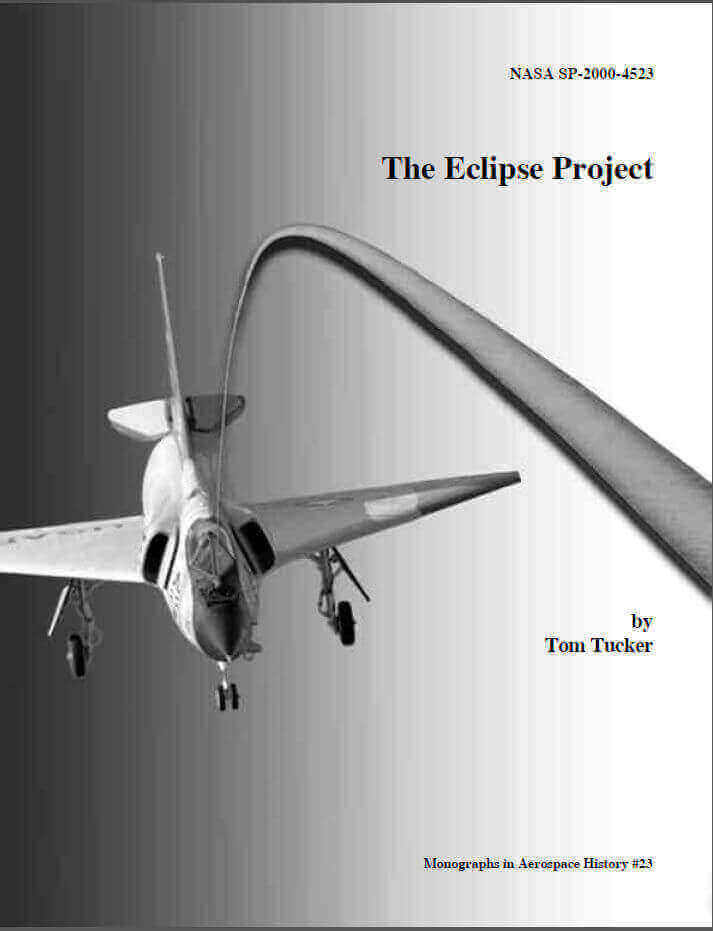
Eclipse Tow Launch of QF-106A 59-0130, a NASA assigned projects aircraft, takes off in tow behind by a C-141A Starlifter.
In 1997 and 1998 the Dryden Flight Research Center at Edwards, California, supported and hosted a Kelly Space and Technology, Inc.(KST) project called Eclipse, which sought to demonstrate the feasibility of a reusable tow-launch vehicle concept.
The Eclipse Project NASA homepage is comprised of three phases: wake turbulence assessment, air data calibration, and tethered operations.
These tests included a Combined Systems Test of both airplanes joined by a tow rope, a towed taxi test, and six towed flights. The primary goal of the project was demonstrating the tow phase of the Eclipse concept using a scaled-down tow aircraft (C-141A) and a representative aerodynamically-shaped aircraft (QF-106A) as a launch vehicle. This was successfully accomplished.
On December 20, 1997, NASA research pilot Mark Stucky flew a QF-106 on the first towed flight behind an Air Force C-141 in the joint Eclipse project. Stucky flew six successful tow tests between December 1997 and February 6, 1998.
On February 6, 1998 the Eclipse project accomplished its sixth and final towed flight, bringing the project to a successful completion. Preliminary flight results determined that the handling qualities of the QF-106 on tow were very stable, actual flight measured values of tow rope tension were well within predictions by the simulation, aerodynamic characteristics and elastic properties of the towrope are a significant component of the towing system, and Dryden's high fidelity simulation provided a representative model of the performance of both the QF-106 and C-141Aairplanes in tow configuration. All six flights were highly productive and all project objectives were achieved.
All three of the project objectives were successfully accomplished. The objectives were: demonstration of towed takeoff, climb-out, and separation of the EXD-01 from the towing aircraft; validation of simulation models of the towed aircraft systems; and development of ground and flight procedures for towing and launching a delta-winged airplane configuration safely behind a transport-type aircraft.
The QF-106 was selected by KST because the aircraft has a delta wing platform representative of the Kelly Eclipse Astroliner spacecraft that the company plans to build. The QF-106 is a rugged, reliable aircraft which was available from the Air Force's drone target aircraft inventory. The C-141A was chosen because it can be configured as a tow aircraft with no modification to the airframe.
Two QF-106's, previously assigned to the5th FIS at Minot, were selected to participate in the Eclipse Program:
QF-106A 59-0130, AD152
QF-106A 59-0010, AD246
59-0130 was the primary demonstrator with59-0010 used as its backup airframe however, 59-0010 was never flown in the Eclipse project and was returned to AMARC at the conclusion of the project in 1998.
Wake Turbulence Assessment: The wake turbulence produced by the C-141A and the handling qualities of the QF-106 in that wake were evaluated and assessed in several flights. From the results of these flights it was determined that proper positioning of the QF-106 behind theC-141A provided stable, controllable flight conditions. For one flight test, smoke-generating devices were placed under the C-141A's wings to enable visualization of the aircraft's wake vortices. Also, one of Dryden's F-18 chase aircraft flew at various distances and lateral positions behind the C-141A to probe the wake in an effort to define the wake turbulence environment. Finally, this probe test was replicated by the unmodified QF-106. It was found that both aircraft, particularly the QF-106, were very controllable even in wake turbulence. Testing also confirmed viability of the chosen tow rope length and a low tow position. The modified EXD-01 was flown in the fall of 1997 to obtain the air data calibration with the modified nose boom, which has been shortened to prevent interference with the tow rope. The tethered flights began in late 1997.
Dryden added a research instrumentation system to obtain airspeed, aircraft motion, tow rope tension, and tow rope angle measurements. Modifications to the QF-106included shortening the nose pitot boom and addition of a tow rope attachment and release mechanism. The cockpit was modified to provide the pilot with a tow rope tension display and also the two(an electrical and a mechanical) tow rope releases. A video camera was installed near the aircraft's nose to provide the control room with a view of the tow rope during the flight. These aircraft modifications were performed by Dryden personnel. No significant modifications were made to the C-141A. All of the towing and tow rope jettison equipment will be placed on a standard cargo pallet secured in the rear of the aircraft. A video display of the tow rope and EXD-01 was installed, as well as a flight test instrumentation pallet to obtain C-141A aircraft parameters. Differential GPS will be used to determine the separation distance between the two aircraft.
To enhance flight safety and reduce the number of unknowns during flight tests, the Eclipse project used a high fidelity simulator. Full nonlinear mathematical models of the EXD-01 aircraft, C-141A aircraft, and the tow rope were modeled in the Eclipse simulator which had both a piloted and an off-line, batch version. The former was used for pilot training for normal and emergency operations, while the latter was used for dynamic analyses and for validation of major design decisions. As the flight project progressed the simulation was be validated with flight data. An additional benefit of the fully validated simulation was the ability to extrapolate the Eclipse tow dynamics to larger, future tow launch concepts.
A build up approach was used in the tow demonstration flight phase. That meant each test mission build upon the knowledge and experience gained from the prior test. The first steps were to validate all test and flight procedures. Initial missions would also validate predicted performance of both aircraft, particularly during takeoff and climb out. For subsequent missions, theEXD-01's performance and handling qualities were evaluated at various flight configurations. At first, the EXD-01 was flown in a high drag configuration with landing gear and speed brakes extended, whereas final flights were conducted in a 'clean' or "landing gear up" configuration.
Two tow rope configurations were used. The first flight tests employed a tow rope that consisted of three primary elements: a 1000 foot Vectran rope that is bisected by a 50 foot section of 8-ply nylon strap. Damping characteristics of the tow rope were significantly improved by the nylon segment. Then flight-testing used a tow rope that was made of a single 1,000 foot Vectran element. The two airplanes were staged on the runway, during which the hookup to the tow rope was made. The C-141A then added tension to the tow rope by taxiing forward slowly, then it accelerated, taking off at120 knots airspeed. In tow, with engines at idle, EXD-01 rotated at 130knots and lifted off at 165 knots. The EXD-01 pilot then positioned the airplane in a 'low tow' position at a -20 degrees elevation angle throughout the tow. The EXD-01's engine were at idle power throughout the towed portion of the mission, to enable it to 'power up' rapidly after release for a conventional landing. All towed flights concluded with the release of theEXD-01 from tow at the target altitude.
The Eclipse Project Pilot by Robert "Buzz" J. Sawyer
The pilot for this project was an ex-Marine test pilot named Mark Stucky, who was then (and still is, as far as I know) a NASA test pilot. He was my last F-106 student in August-September 1996. Seems the "six" was very similar in plan-form to the proposed spacecraft. The ultimate plan is to tow a spacecraft off the ground with a jumbo jet, such as a 747, tow it to altitude where it would be through most of the Earth's atmosphere, where they would "light up" the spacecraft's engine(s)as it was released from the tether. That way it would save fuel (and weight), and be more economical than using booster rockets. After attaining orbit, the payloads would be dispensed, and it the "Eclipse” spacecraft would fly back to Earth.
"Forger"(Mark Stucky's nickname/call sign) got a full check out in the six, then took two of our QF-106's to what used to be Norton AFB in San Bernardino, CA, for the mods. They had to get rid of the characteristic pitot boom, for fear it would get entangled with the kevlar tow rope. Then, the shackle (the drag chute jaws mechanism of a B-52) and release system had to be installed. From what I understand, Forger only got three (or four?) towed sorties.
He took off with a minimum amount of fuel (for reduced weight) with the speed brakes open and left the landing gear down (limit speed is 285 KCAS). This simulated the drag characteristics of "Eclipse" compared to the C-141 tow ship. The engine was left at idle to provide hydraulic power for the flight controls(and in case he needed to cut free and fly on his own) After being towed to somewhere around 20,000', they would cut him free, and he would return to Edwards for a normal landing. He said that on his last sortie he had them cut him free right over Edwards, where he flew a simulated flame-out landing (SFO)--having flown an entire sortie or about 50 minutes without ever moving the throttle out of idle!
Of course no one here at Holloman (or Tyndall) thought much of being towed like a glider in anF-106. The project acquired the nickname "Dope on a rope" when we first heard about it. Mark wasn't very fond of it during his training here, but when he returned after completion of the project, he said he preferred "dope on a rope" to what the NASA folks at Edwards were calling him--"The Drag Queen!"
Before taking his2 jets to AMARC after project completion, Mark became the last official F-106instructor pilot, giving the other test pilots instruction on flying the 106. Seems they all wanted to fly this "classic" before they went into terminal storage. Forger gave us a bunch of great pictures--copies which appear on your site.
... Robert "Buzz" J. Sawyer, FSAT Site Manager, Lockheed Martin, Holloman AFB, NM
To enhance safety of flight, simulations of the two airplanes were implemented along with a simple mathematical model of a towrope. A computational simulation of an F-106 airplane had been implemented at Langley Research Center to support some vortex-flow flight experiments, and this simulation was revived at Dryden. The C-141 simulation was adapted from an existing B-720 simulation at Dryden by replacing the mathematical model of the aerodynamics of the B-720 airplane with linear aerodynamic coefficients based on the performance of the C-141 airplane. The mathematical model of theB-720 engine was modified with a thrust multiplier to match the C-141 static sea-level thrust. In addition, the simulation was updated with C-141 weight, inertia, and center-of-gravity data. Existing simulation cockpits were used without modification.
The tow-rope model assumes that the tow rope lies on straight line between the two airplanes. On the basis of results from laboratory tests, the rope tension was modeled as quadratic in elongation and linear in elongation rate. This tow-rope model was verified initially by implementing it in a glider simulation and having a glider pilot subjectively evaluate the performance.
Initial studies were performed with the F-106simulation alone. In these studies, it was assumed that the C-141 airplane was a point mass that would be unaffected by the forces on the tow rope. C-141takeoff trajectories were generated and recorded in the C-141 simulation. These trajectories were played back in the F-106 simulation to study the takeoff performance of the towed F-106. This first cut showed some interesting results. The F-106 performance on tow was quite different from that of a sailplane. There appeared to be a lower and an upper bound on the tow angle between the two airplanes. Flight beyond these bounds would cause divergent pitch and sometimes roll oscillations. Fortunately, the oscillation amplitude would increase slowly enough that the pilot was able to recognize the problem and correct for it by flying back within the bounds. The simulation was already providing important information to the flight-test team.
To make the simulation study more realistic, it was decided that simulations of both airplanes should be performed simultaneously. To do this, it was necessary to link two independent six-degree-of-freedom (6-DOF) simulations — essentially creating a 12-DOFsimulation. Although this seemed challenging at first, it turned out to be quite simple. The two simulation computers were linked with a fiber-optic reflective memory interface; this linkage enabled the sharing of airplane positions, velocities, and tow-rope forces between the two simulations.
To obtain consistent results, it was decided to synchronize the two simulations. The frame rates of both simulations were increased to 100 Hz, and flags in shared memory were created to enable the simulations to synchronize by polling. The interrupt driver in the F-106simulation was used to generate the 100-Hz frame pulse, and the C-141simulation simply waited for the F-106 simulation to indicate that a new frame should be started. The synchronization scheme is shown in Figure 2.
The results of the linked simulations confirmed the results of the F-106 simulation. The assumption that the C-141 airplane could be treated as a point mass turned out to be a good one. The C-141 pilot could not feel the effects of the F-106 doing normal small-amplitude maneuvers on tow.
The availability of two independent simulations also afforded a capability to achieve quicker, more productive, simulation sessions. Instead of generating a C-141 trajectory and then preparing and transferring the resulting data for playback in the F-106 simulation, theC-141 pilot could simply hit a "simulation reset" button and immediately try a different takeoff profile. This enabled the F-106 test pilot to quickly get the feel of the towed operation, and soon this pilot's task became easy. This setup also proved valuable for evaluating various failure scenarios during full mission simulation with the control room being fed by a stream of data generated by the simulator and transmitted by pulse-code modulation.
An animation illustrating the Astroliner Reusable Launch Vehicle (RLV) the F-106 program was testing for. Another approach to the problem of achieving HTOL from Kelly Space & Technology (KST) - towing the vehicle like a glider at take off in order to save using fuel in the early part of the flight, thereby starting at high altitude with full propellant tanks.
KST Reusable Launch Vehicle Technology
KST Reusable Launch Vehicle Part 2
Eclipse - NASA Dryden Flight Research Center
Eclipse Status -NASA Dryden Flight Research Center
NASA Photos
© Copyright F-106DeltaDart.com Founded 1998
Privacy | Terms of use | Site Map | Contact