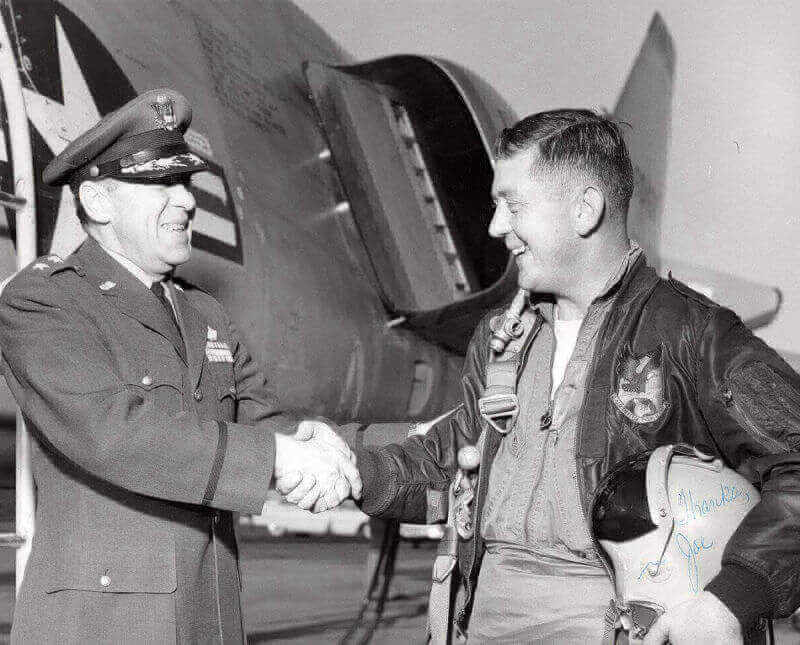
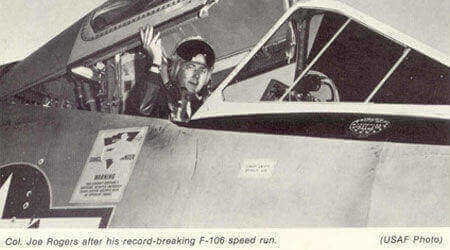
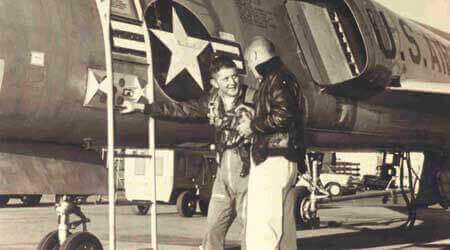
Pilot: Maj Joe Rogers in 56-0467
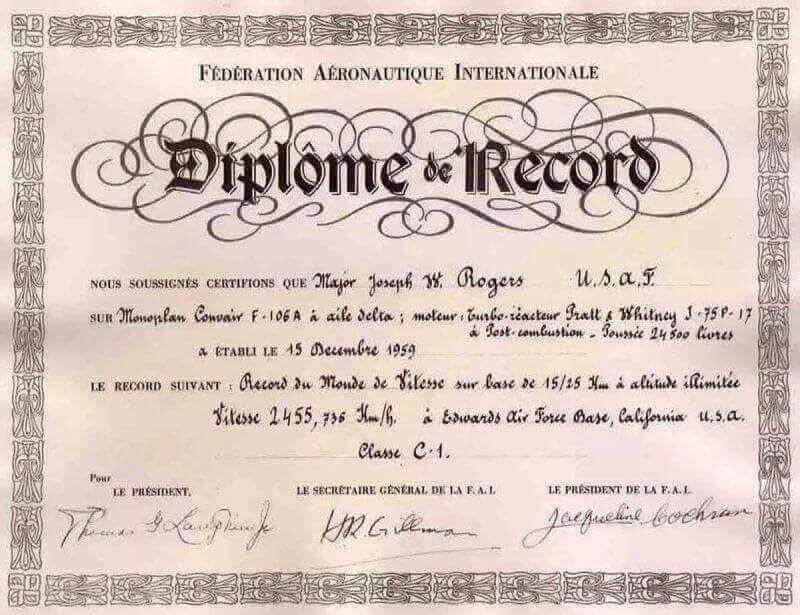
On December 15, 1959 Major Joe Rogers of the United States Air Force Flight Test Center flew F-106A Serial Number 56-0467 on a straight line eleven mile (18 km) course at an altitude of 40,00 feet (12192m) to a measured world absolute speed record of 1,525.95 mph (2455.77km/h) Mach 2.39, surpassing the previous record of 1,484.3mph (2388.95km/h) set on October 7, 1959 in a Mikoyan Ye-6/3, a.k.a. Ye-66 (Mikoyan-Gurevich MiG-21F-13 with different engine) flown by Colonel Georgi Mosolov of the USSR by 34.63 mph (55.73 km/h).
As an Air Force test pilot, Major Joseph W. Rogers brakes a Soviet speed record in 1959 when he flew an F-106 Delta Dart at 1,525.95 miles per hour over Edwards Air Force Base. The record, verified by national and international aeronautics agencies, has never been broken.
The Aircraft
The aircraft F-106A serial number 56-0459 that had originally been chosen for the record attempt, and what many history books still incorrectly show as flying the record breaking speed run, had a specially fine tuned and tweaked engine for the attempt, but had been experiancing engine compressor stall problems resulting in violent yaw oscillations and developed problems with the variable engine air intake controls just hours before takeoff so it was sidelined. The designated backup, 56-0467, had not received any special preparation other than backing out the Limit Screws on both Engine and Afterburner Fuel Controls to allow over-limit operation by the pilot. Maj Rogers then took her up a new record was set. He later noted he actually sailed through the traps at Mach 2.43 and was still accelerating at the end of the course.
The absolute record stood until November 22, 1961, when an McDonald F-4H-1F twin-engine Phantom flown by Lieutenant Colonel R. B. Robertson also of the United States Air Force Flight Test Center set a new record.
While it is still recorded the F-106 continues to hold the world single engine speed record, it is claimed by the Soviets that they broke that record, as well as the world absolute speed record on July 7, 1962 in a single engine Mikoyan Gurevich Ye-166 (a name adopted for the record attempt and originally a version of a Ye-152) once again flown by Colonel Georgi Mosolov of the USSR to a claimed 1,665.98 mph (2,680.92 km/h). However, that claim has never been substantiated.
You may be asking yourself, if the claimed maximum speed of an F-106 is 588 knots or 676.2 statute miles per hour how could a basic un-pampered F-106 set a record speed over twice that fast? MAGIC! This record run still stands today [as of 28 Feb 2020] for a single engine aircraft. I wonder what the tweaked 56-0459 could have done?
After The Speed Record "The Rest of the Story"
After landing, the aircraft exhibited graphic physical evidence of its high-speed flight. Paint was burned on the leading edges of the wings and air inlets and was partly missing on the vertical fin. Canopy side panels were slightly deformed from heating. The stock engine was a complete write-off, and it's a wonder it even lasted through landing.
Joe Rogers received the Distinguished Flying Cross and became the 25th recipient of the Thompson Trophy. He later went on to a distinguished air force career.
Serial number 56-0459 was eventually rebuilt during the T-T-T program and received a new forward fuselage section. It always flew straight after the rebuild and survived to become a display aircraft at the McChord Air Museum.
The record-setting aircraft (S/N 56-0467) also went through the T-T-T program and received a special placard on the right side of the cockpit, properly memorializing its record flight.
After rebuilding during the T-T-T program, this historically significant aircraft was assigned to the 329th FIS at George AFB, California, on 5 June 1961. Unfortunately, two months later it was destroyed during an emergency landing on 14 August 1961. That morning, the right main tire blew out on takeoff. Pilot James Wilkinson burned off fuel and was advised to land at Edwards, where they had better crash equipment.
The pilot found he was also unable to open the speed brakes, which meant the drag chute could not be deployed. The crash crew foamed the runway, but with no right tire, no speed brakes, and no drag chute, it would be almost impossible to land safely. As the right wheel contacted the runway, it immediately began to spark and then disintegrated. Pieces flew up through the wing, starting a fire, and the aircraft eventually slid off the runway and into the desert. Although the pilot egressed safely, all he could do was watch as the record-setting iet burned to a charred hulk.
Although the absolute speed record has been raised significantly since 1959, the FAI still recognizes the F-106 as the world's fastest single-engine jet-powered aircraft.
And that money made by Convair? As the official USAF engine test aircraft, the engine in -467 came with special afterburner fuel-flow instrumentation not found on any of the other engines. For the speed run, the limit screws on both engine and afterburner fuel controls were backed out to allow over-limit operation by the pilot. After the flight, review of the data showed the afterburner fuel control schedule was not providing enough fuel for maximum afterburner performance. This discovery allowed Convair to recover about half a million dollars in performance penalties from the air force.
The Two Contenders
There are two primary contenders for the highest speed ever reached by an aircraft carrying a single jet engine. The first is the American F-106 Delta Dart air defense fighter. In late 1959, the manufacturer Convair joined the US Air Force in taking one F-106 with the serial number 56-0459 and modifying it to maximize the plane's record-setting potential. The goal of this effort, called Project Firewall, was to break the world absolute speed record of 1491.26 mph (2,399.95 km/h) that had been set by a Soviet Ye-152-1 on 7 October 1959. The Ye-152-1 was a special test version of the MiG-21 fighter that had also been customized to set speed, altitude, and climb records.
The improved F-106 completed a number of test flights in early December 1959 with Air Force test pilot MAJ Joseph Rogers at the controls. During two weeks of testing, Rogers pushed the F-106 to its limits to prove out the modified design. Unfortunately, each flight was marred by engine compressor stalls that resulted in violent yaw oscillations. Although engineers and mechanics attempted to adjust the engine and eliminate the undesired behavior, no successful correction could be found. The test team was forced to remove the modified F-106 from the program and instead use a standard production vehicle for the remainder of the test effort.
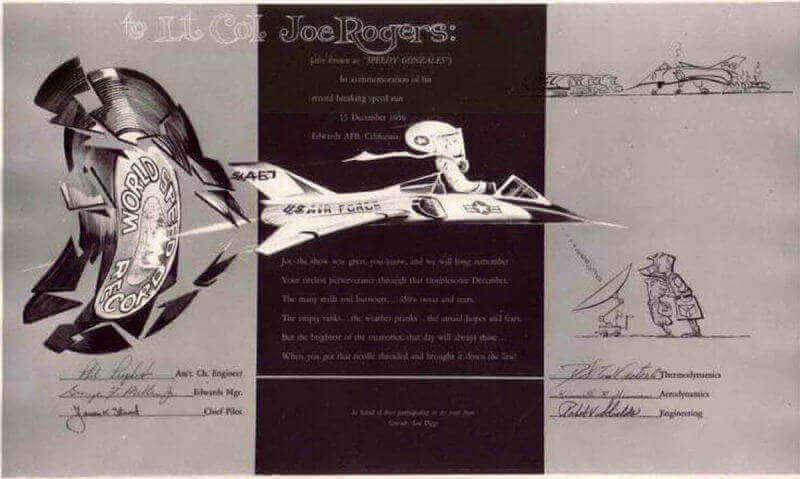
The back-up plane was serial number 56-0467 and made its attempt at the world speed record on 15 December 1959. During his very first flight in the new F-106, MAJ Rogers successfully broke the record previously set by the Ye-152-1 and claimed a new speed of 1,525.95 mph (2455.78 km/h) at an altitude of 40,000 ft (12,190 m). That speed at that altitude equates to about Mach 2.31. The record was set over an officially recognized straight line course 11 miles (18 km) in length, and Rogers reported that his speed might have been even higher since the plane was still accelerating as it left the course. For his exploits, Rogers received the Distinguished Flying Cross, the DeLavaulx Metal, and became the 25th recipient of the Thompson Trophy.
The Soviets, meanwhile, resurrected the Ye-152-1 test aircraft in hopes of recapturing the speed record. The Ye-152 was based on the earlier Ye-150 and both were developed as improved versions of the MiG-21. The Ye-152A used two of the engines of the basic MiG-21 with a modified nose inlet and other aerodynamic modifications to improve rate of climb and maximum speed. The Ye-152-1 was a further modification of the Ye-152A with an enlarged wing and revised tail design but returning to a single engine layout. Yet another variation was the Ye-152-2 that tested additional minor modifications to the design.
These two test aircraft were followed by the definitive Ye-152M that was intended to be the prototype of a new air defense interceptor. This model featured increased fuel capacity in an enlarged fuselage spine, a more powerful engine, and a more advanced missile and avionics combination than the earlier MiG-21 series. A further test aircraft based on the Ye-152M was the Ye-152P that included canards and other aerodynamic features. In spite of these many concepts and advanced prototypes, the Ye-152 series was eventually abandoned once the Soviet Union decided to proceed with the MiG-25 instead.
Before the MiG-25 came along to set its impressive speed records, however, the Ye-152-1 reportedly set a new record of its own about 2½ years after Joe Rogers' Mach 2.31 flight in the F-106. The feat was said to occur on 7 July 1962 when test pilot Colonel Georgi Mosolov achieved a new mark of 1,665.85 mph (2,680.92 km/h), or about Mach 2.51. However, no proof of the flight was offered and the record is still considered unverified.
To confuse matters even further, the always secretive Soviets reported the name of the plane that set the records in 1959 and 1962 was not the Ye-152-1 but the Ye-166. Even today, a plane painted as the Ye-166 is on display at the Russian Central Museum of the Air Forces at Monino (English site about the Museum) and said to be the record-setting test aircraft. In actuality, this aircraft is the later Ye-152M and is only painted to represent the actual Ye-152-1 (aka Ye-166 or E-166). The fate of the actual historic Ye-152-1 is unknown, but perhaps it was lost in an accident and a similar plane substituted to take its place.
The record-setting F-106 too suffered its own inglorious fate. After Joe Rogers used F-106 S/N 56-0467 to exceed Mach 2.3, the plane was returned to regular service with the Air Force. The plane, the eighteenth F-106 to be built, was transferred to the 329th Fighter Interceptor Squadron based at George Air Force Base in California. The plane remained in service for just a couple years after its famous record-setting flight before disaster struck. As pilot James Wilkinson was taking off on a training flight on 14 August 1961, the right main landing gear tire blew and the rubber broke apart from the wheel hub.
The pilot and ground controllers decided it would be best to remain airborne and burn off fuel before attempting a landing at Edwards AFB to the north, which had a longer runway and better crash equipment. Wilkinson landed the plane on the intact left and nose gear and tried to keep the right gear off the runway as long as possible. Once the right gear came down, however, the wheel hub quickly sent up a shower of sparks before breaking up and impacting the wing. This rough landing started a fire in the wing that rapidly grew to consume the entire aft half of the plane. The pilot successfully climbed out of the cockpit and ran to safety after the F-106 finally came to a stop, but the plane was unfortunately declared a total loss.
Ironically, the F-106 Joe Rogers had originally flown during Project Firewall does still exist today. F-106 S/N 56-0459, only the seventh model off the assembly line, ultimately became part of the 318th Fighter-Interceptor Squadron at McChord AFB in Washington where it was retired in 1983. The plane was then donated to the McChord Air Museum where it remains on display. Many mistakenly believed that this F-106 was the one Joe Rogers had flown on his record-setting flight in 1959 and were unaware of the last-minute switch to the back-up aircraft. It was only many years after the plane went on display that the true story about the flight was discovered and Joe Rogers set the record straight.
Joe Rogers enjoyed a long and successful career in both the Air Force and as a civilian contractor. Joe first joined the Army Air Corps in 1943 and became a pilot instructor during World War II. His first taste of combat came in Korea where Rogers claimed a rare kill against a MiG-15 jet while flying a piston-engine P-51 Mustang. Rogers later transitioned to the jet-powered F-80 Shooting Star and completed nearly 200 missions before the end of the Korean War. Now holding the rank of Major, Rogers graduated from the USAF Test Pilot School and joined the F-86D, F-102, and F-106 flight test programs.
Following his record-setting F-106 flight, Rogers returned to front-line duty and took command of the 317th Fighter Interceptor Squadron flying the F-102. Rogers re-joined the testing world again for a few years when he became a test pilot for the SR-71 and YF-12. He rounded out his career with over 40 combat missions in Vietnam aboard the A-37 Dragonfly and F-4 Phantom II before retiring with 29 years of service at the rank of Colonel. Rogers was then hired into the Fighter Division of Northrop where he helped market the F-5 Tiger family for thirteen years. Joe Rogers remained passionate about the aerospace world throughout his life until he passed away in 2005.
A Third Contender
A third possible contender for the fastest single-engine turbojet might be the Soviet MiG-23 fighter developed during the 1960s. Many sources credit the aircraft with a maximum speed of about Mach 2.35 at an altitude of 36,000 ft (10,975 m). This combination of Mach number and altitude results in a speed of approximately 1,555 mph (2,500 km/h), which is higher than the official record set by the F-106.
Although the MiG-23's mark is still lower the record claimed by the Ye-152-1, that record remains unconfirmed. If there is conclusive evidence that the MiG-23 ever achieved Mach 2.35, this aircraft would likely be considered the world's fastest turbojet. Unfortunately, we have been unable to locate any records, official or otherwise, that provide proof the MiG-23 ever actually flew at this speed. -- by Jeff Scott and Greg Alexander
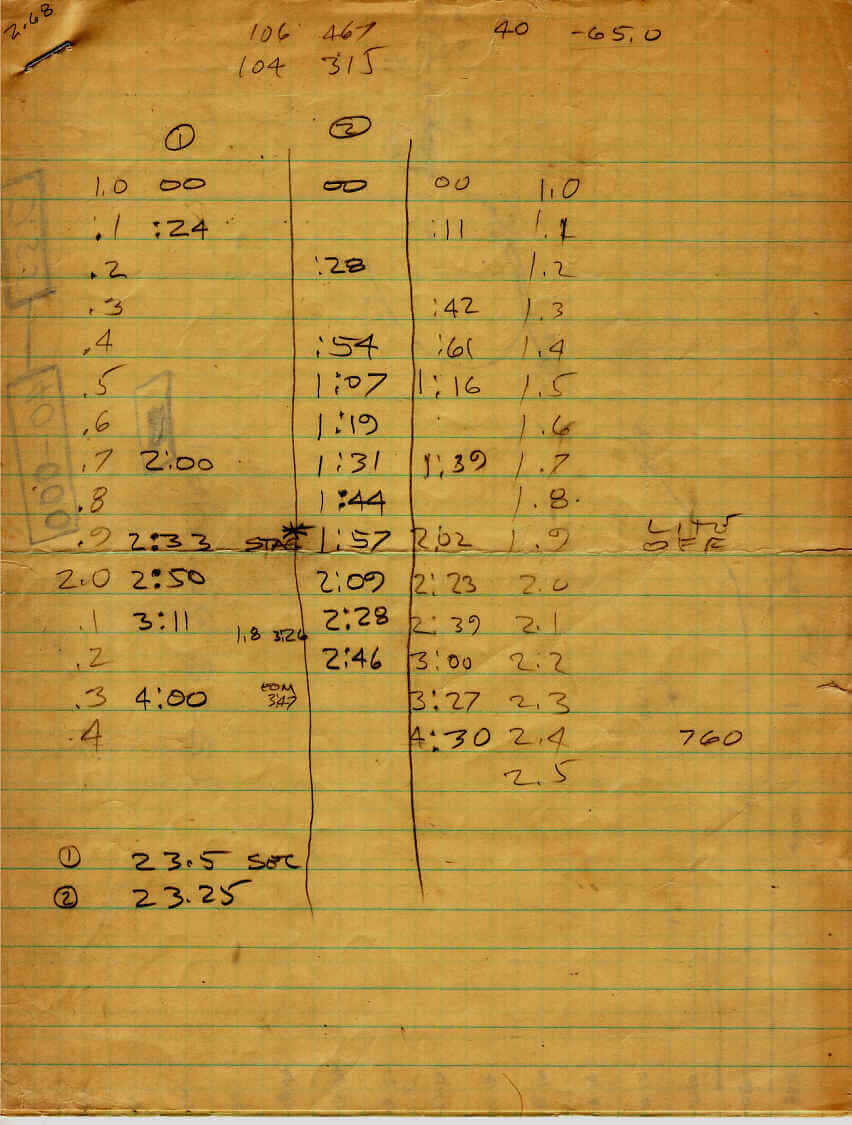
To begin with, I understood some in Convair upper management argued strongly against exceeding the design limits of the aircraft for the record attempt. My impression was that it was a pretty heated dispute and those in favor obviously won out.
Here are the rough notes I wrote during the 56-0467 speed run. Columns circled 1 and 2 are each acceleration and times. The far right column has the Mach numbers. I believe the final call on the actual Mach was 2.42. At the top I noted the aircraft as 467 and the F-104 chase as 315 and temperature at 40k was -65F. I’m not sure of the actual run altitude, but typically, the optimum was around 35-38K’ where airframe drag was low and engine thrust was good. Some years later, when the F-14 performance information was available, someone from our aero group reportedly overlaid the F-106 performance envelope on the F-14 and found there were some places where the F-106 was better (presumably high altitude maneuverability).
When the F-106 was selected to try for the 15KM speed record, 459 was the logical first choice, since it was already instrumented for performance but somehow the unsolved yaw problem was either ignored or overlooked and it turned out to be a show stopper for 459 in that role. During the initial speed tries, the yaw problem was severe enough to affect the air flow to the engine and at high speed the unbalanced flow induced engine compressor stalls. Compressor stalls at near Mach 2 can be quite disconcerting. A compressor stall is basically when the engine backfires and airflow reverses in the intake duct.
One theory to fix the stall problem was the inlet ramp schedule was linear and really needed a steeper slope above A/C Mach 1.8 for optimum airflow to the engine. A second slope was provided in the controller and was manually switched by the pilot using the stick trigger switch. It would be switched over at about M1.8 going either way. This helped, but did not totally cure the problem. We also tried field measurement of 459 (transit, plumb bob and tape measurements) to look for any alignment clue to the yaw problem but nothing was found (or could be, considering the relative crude measurement implements.)
At this point, it was painfully obvious that 459 was not going to work, so an arrangement was made with the AF test group to borrow 467 for the speed run attempt. It was moved over to the Convair hangar and the additional special instrumentation required by the FAI to prove performance was transferred from 459 to 467. Also, P&W had provided two special what I called “racing engines” for the runs. These came with some additional instrumentation, I think, because the engines were expected to be operated beyond normal operating limits which were set to extend engine life. The limits included RPM, inlet air temperature and EGT. To allow for disc expansion at the higher RPM, extra clearance was provided for the wheels to expand without scraping the housing.
Time was running out to meet the speed run schedule and the second shift crew at Convair pulled some miracles and deserves major credit for the final success of the runs. One was three complete engine changes including swapping instrumentation, installation kit and trim runs in one night. Both the special racing engines failed to meet trim run figures and were finally replaced by the original engine that came with 467.
The next day was the last day available for the F-106 to try for the record. The AF had an F-104 ready as a backup and was standing by for the results of the test flight. P&W had approved raising engine limits on the “stock” engine in 467. Our radio communications setup was in an 8’ high walled cubicle in the hangar and I remember work benches against the wall on the outside of the cubicle. The Convair project pilot, James Stuart, flew 467 that morning on a one way pass and reported numbers that were really spectacular. The communications cubicle was packed with people listening to the radio. There were even some standing outside the cubicle as well. Everything was finally coming together for the official run.
Unknown to us at this time was that Col. Queen and Maj. Rogers had decided over dinner the night before that the plug would be pulled on the Convair effort and they would fall back to the F-104 which really had less potential for the record attempt. Maj. Rogers and Col Queen had arrived in time to hear the numbers Jim was reporting and were standing on the workbench outside the cubicle with their heads with smiling faces peering over the top of the wall. They had instantly changed their mind about switching aircraft after hearing Jim’s report and I remember Joe telling Gene Crane, our radio operator on the flight, to tell Jim to be sure and remember to “put the landing gear down because they wanted that aircraft.” And as they say “the rest is history.”
I understood there was a friendly dispute between Jim and Maj. Rogers as to which of them actually flew the fastest flight. We’ll never know but the record has Maj. Rogers’ name on it.
Something that needs to be kept in mind is that these test aircraft had none of the fine production aircraft avionics like autopilot and altitude hold. The aircraft were hand flown and part of the FAI rules stated the aircraft could not dive through the 15KM range or vary altitude outside a 1500 foot altitude range once passing the wire on the first run. That meant the pilot had to keep within that range after entering the run and including the turn back to complete the second pass. Because of the tight altitude limits for the pass, a special new type (for then) of rate of climb indicator was installed. I believe most rate of climb instruments at the time relied on sensitivity to changes in pressure to provide an indication. The new instrument incorporated a built in accelerometer, as it would provide a more accurate indication of vertical speed which was crucial to the pilot. The instrument was placed at top center position on the instrument panel and is in the picture of the instrument panel.
After the flight, we looked the aircraft over and found plenty of evidence of high speed abuse including paint burned on the wing leading edges and engine air inlets where the shock wave impinged and the leading edge of the side canopy panels had deformed slightly between the attachment screws from the aerodynamic heating.
Somewhere in my archives, is the P&W engine teardown and inspection report for the speed run engine. It basically says it is total junk. The discs were stretched and I believe the aft turbine bearing was shot. I know at least one of the rear turbine stabilizer struts was only attached by the center point and the loose end was trailing pretty much straight aft.
One very valuable outcome of the speed run for Convair was because the engine used came with A/B fuel flow instrumentation which was not on the other engines. For the runs, both the engine and A/B fuel control limit screws were backed out to allow over-limit operation by pilot control, and the instrumentation showed the A/B fuel control schedule was not providing fuel for max A/B performance. This discovery allowed Convair to recover something like $500,000.00 in performance penalties.
Another interesting sidelight was because of the high fuel consumption required for the run; it was decided to use higher energy JP5 fuel and tow the aircraft to the end of the runway rather than use fuel for taxi.
After the test program, most, if not all, of the production test aircraft were processed through the “Test to Tac” program where they were rebuilt into production configuration aircraft, including 459. Part of the rebuild included replacement of the entire nose section from aft of the cockpit. As far is I know, after the mod, 459 flew as straight as an arrow, so the problem could have been in the original build when a slightly crooked nose was installed.
I am privileged to visit frequently with Col. (Ret) Joe Rogers, who set the still standing single engine speed record. There is an interesting historical matter that I was for a long time a believer in, and others in a different way. Until a year or so ago there were two F-106s that were credited with setting that speed record, 459 which we still have an affection for, and another somewhere back East. This came to Joe's attention somehow, and he set the record straight by pointing out that he set the speed record in 56-0467, which was unfortunately destroyed years later at EDW when the brakes caught fire. Stories below on 0467's demise by the actual pilot and crewchief: Pilot Account, Crewchief Account. Interesting aspects of the story are that 459 was to be used for the flight, but the intake ramps [vari-ramps] weren't working properly the day before, so the switch was made to 467 [the spare]. The switch may have been the source of the mistake in history, or maybe Joe's affiliation with that (wonderful) painting of 56-0459 was more the cause of some misunderstanding. I'll ask him what he thinks of all this. [The] magazine Wings of Fame, [issue] #12 has an excellent article on the Dart by Bob Dorr. If Mr Dorr is correct and the last Dart (59-0130) flew to Davis Monthan on May 1 last year, I was a witness to the last flight. I can report that the airplane in flight commanded attention and was beautiful beyond compare to the end. Someone put an F-16 on it's wing so that this would be clear to all. Best wishes. thanks for sharing your F-106 experiences... Mark D. Harlin"
"Just a note to set the record straight about the demise of F-106 56-0467. I have the dubious distinction of being the pilot who landed (?) this bird at Edwards AFB on its last flight. Ken Robken's account of the accident (below story) is amazingly accurate with but a few minor exceptions.
The right tire blew (all the rubber came off) just as I broke ground on take off and I had no idea that it happened until I was starting into my intercept training mission. The mobile control officer had seen the tire blow and immediately called 329th operations. At that point everyone and his sister got on the horn (radio) and started giving me advice. Talk about a circus! My ops officer, Bob Furgeson, finally called Convair to try to get some guidance as to how to handle the situation because there was no procedure in the T. O. for landing with no tire on a wheel. The decision was made to burn down fuel and go into Edwards because they had a longer runway and much better crash equipment than George.
After burning down my fuel, I started my decent into Edwards and, in the process, discovered that I also had speed brake failure. I set up a straight in approach, touched down on the left gear (good tire and wheel) and held the right (the wheel without the tire) off as long as I could and still have enough speed to put it down gently. I pulled the emergency drag chute and it also failed. Needless to say, this thing was not slowing down quickly enough to suit me with just the left wheel brake and no chute. Fortunately I still had good nose wheel steering and some elevon control, which allowed me to keep it going straight. The foam on the runway was totally ineffective in preventing the wheel break-up and subsequent fire. It was however successful in making it very difficult to keep the pointed end of the aircraft headed the right direction.
At the moment I gently let the right wheel down, Edwards tower started giving me a running account of what was going on behind me. In a very calm voice it went something like this: "You have sparks coming from your right wheel". "Your right wheel is breaking up". "Your right wing is on fire". "The whole back of the aircraft is on fire, get out"! Unfortunately I was still doing about 75 knots when I got that last transmission and I did not have the 0-0 ejection seat so things immediately got very busy in the cockpit. Raising the canopy at this time was no help in slowing this mobile barbeque pit down. I shut the engine and fuel off hoping it would somehow prevent a very loud noise that I was convinced I would not be privileged to hear. To this day I am not sure how I kept it on the runway as long as I did. It wasn't until the aircraft had slowed considerably that it slowly drifted off the left side of the runway. When it became obvious it was going to come to gradual stop in the desert, I started releasing my harness and generally disconnecting myself from the aircraft. The moment it stopped I was over the right side (up wind side trying to avoid jumping into or through the fire) and to this day I contend I set the worlds record for the 100yd dash after hitting the ground.
A fellow named Charlie Demarq came over from George that same day in a "B" model and took me back to the squadron. My squadron commander, little Joe Rutgers, met me on the ramp with some "medicinal" spirits, which quickly took the edge off the whole experience. The accident investigation board met and I told them the whole bloody story including a remark about how it took a little more effort on final approach to find the right power setting because I had no speed brakes (normally extended on final approach). From this they concluded that I must have landed too fast which in turn contributed to the wheel break-up, fire et al. At this point I saw my flying career quickly going down the tubes. Fortunately for me this aircraft was equipped with a Convair data recorder and when the squadron Convair Tech Rep Joe Hitch heard about my difficulties with the board he kindly offered to provide the recorder info. It turned out that I had touched down within a couple knots of the T.O. speed for my weight so I was off the hook. Four thousand jet fighter hours later I retired without so much as having put a scratch on another bird.
I have a couple B & W 8x10 photos of the aircraft taken just after the fire was put out and would be happy to send copies to anyone who may be interested (computer image not hard copy). In addition, I believe I still have a small reel of 35mm stop action film taken by Edwards tower of the entire sequence from touchdown to when it stopped in the desert - Jim Wilkinson, fka Jim Mueller
"I am a former crew chief on the F-106 assigned to the 329th FIS, stationed at George AFB from 1960 to 1963. Our original assignment of "Sixes" included tail numbers 90104 to 90135, with 3 B models numbers 90161, 90162 and 90164.
I just read about the speed record sent to you by Mark Harlin on tail number 56467. In late 62 or early 63, we were assigned 56467 to replace 90120 that flew into a mountain close to the Cuttyback firing range. He was correct that 56467 set the speed record, but was incorrect about the demise of that aircraft.
56-0467's last flight started out on a normal morning training mission at about 0930. The aircraft blew a tire on takeoff, and the pilot (I don't recall his name, but would be able to pick him out in a lineup) said that nothing could be gained by landing the aircraft until the fuel was burned out of it, so he completed his training mission and landed it at Edwards AFB. The fire department at Edwards foamed 5,000 feet of runway, and the pilot set the crippled tire right on the end of the foam and guided it straight down the runway. The bird spit the tire and was riding on the rim until the wheel caught fire, broke up and sent a piece of the burning wheel through the wing. The aircraft caught fire and burned everything aft of the intakes. The pilot jumped out of the flaming bird when he got it stopped, and suffered a bruise to his left heel.
I was on the flightline the morning of the ill fated flight, and talked to the pilot when he returned to George AFB. One thing for certain is that he never touched the brakes on the crippled left gear... Ken Robken"
There are stories published that the speed record should have gone to Charles E. “Chuck” Myers who flew an F-106 at 1544mph in Dec 1959, but that Cold War political pressures dictated that the award go to a military pilot.
According to unconfirmed and inconstant stories, in 1960 he set the world speed record by flying an F-106 Delta Dart (serial number unknown) to 1,544mph, but due to political pressure at the time the official record-holder was to be held by a military pilot as a show of American military supremacy over the USSR. So, the public honor went to Major Joe Rogers USAF who had just recently flown the 1525.93mph run. Myers’ contribution didn’t go completely unrecognized as he received a gold watch to commemorate his achievement, which is said to be engraved with the below as roughly seen in the photo:
Appreciation
C.E. Myers, Jr.
World Record Speed
1544 mph
Dec. 1959, EAFB
F-106A
True story? Without documentation to prove it, the stories are just that - stories written on websites and in books written by un-substantiating writings, so we will probably never know. The record books however, are documentation, so that's what will be remembered.
https://www.pogo.org/analysis/pogo-remembers-chuck-myers-fighter-mafia-veteran